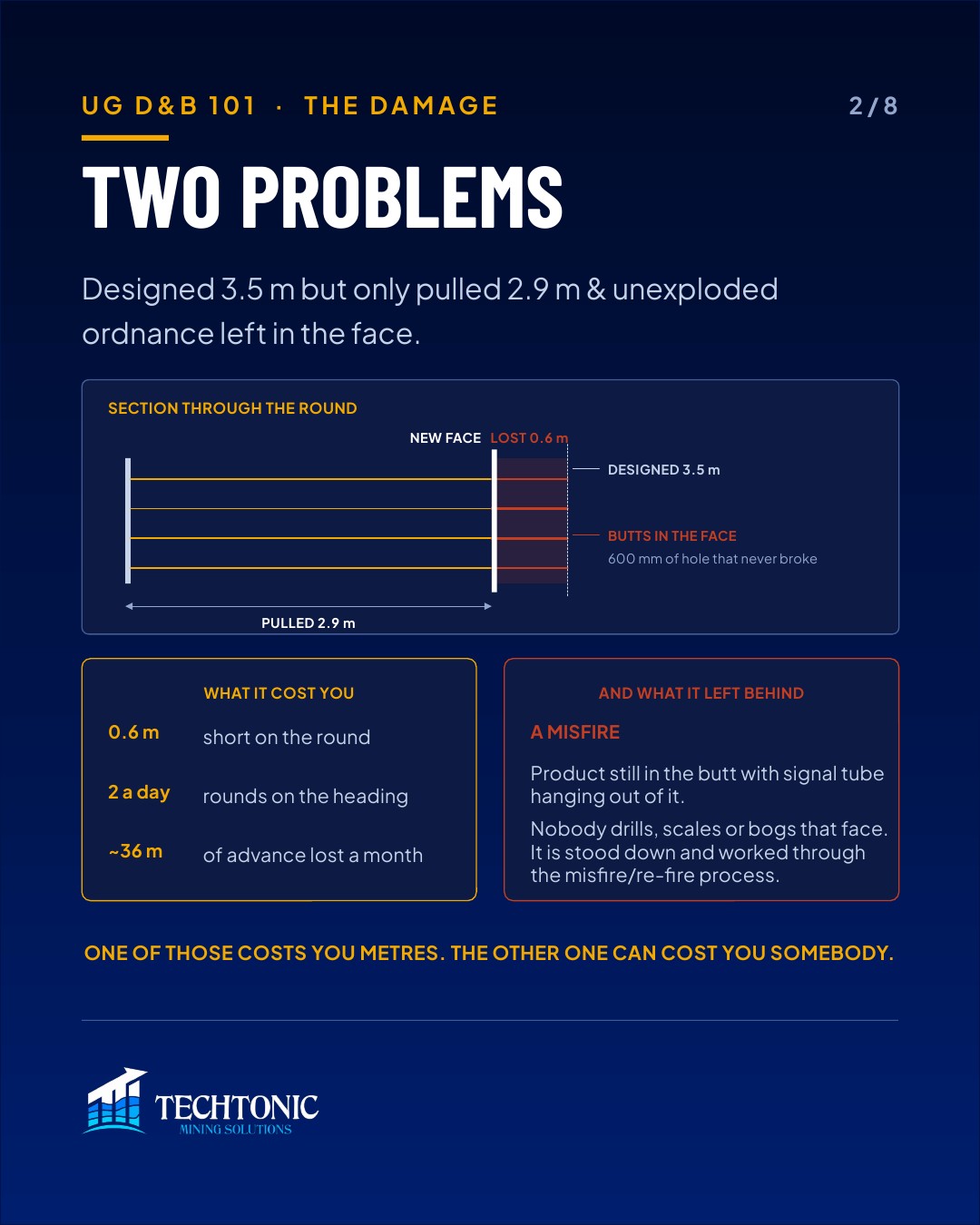
The round fired, the crew bogged it out, and the face they were left with is six hundred millimetres shy of where it should be. The butts of half a dozen holes are still visible, two of them with emulsion still in the hole and signal tube hanging out.
That face is a report. It tells you which part of the round failed, if you know where to look.
Two problems
The round was designed for 3.5 m and pulled 2.9 m. Six hundred millimetres short, two rounds a day, is about thirty-six development metres lost a month — the most expensive number in the heading, and almost nobody measures it.
The second problem is worse. Product still in a butt with signal tube hanging out of it is not a productivity problem at all; it is a misfire. Nobody drills, scales or bogs that face. It is stood down and worked through the misfire and re-fire process. One of those problems costs you metres. The other can cost you somebody.
The rule it broke
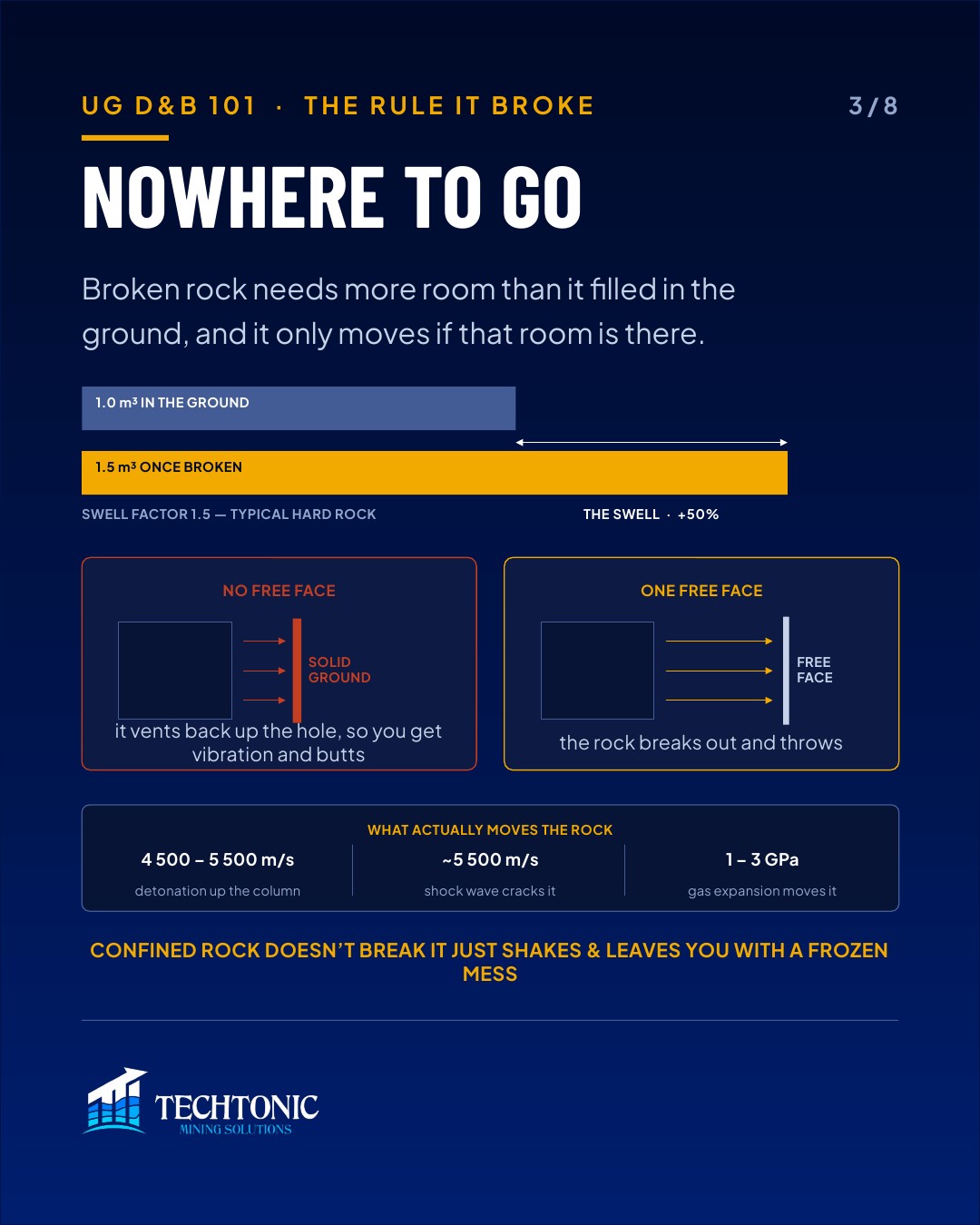
Broken rock needs more room than it filled in the ground — about half again, with a swell factor of around 1.5 in typical hard rock — and it only moves if that room is there. Detonation runs up the column, the shock wave cracks the rock and the gas expansion moves it. With no free face, the energy vents back up the hole and you get vibration and butts. Confined rock does not break; it just shakes.
Read the face
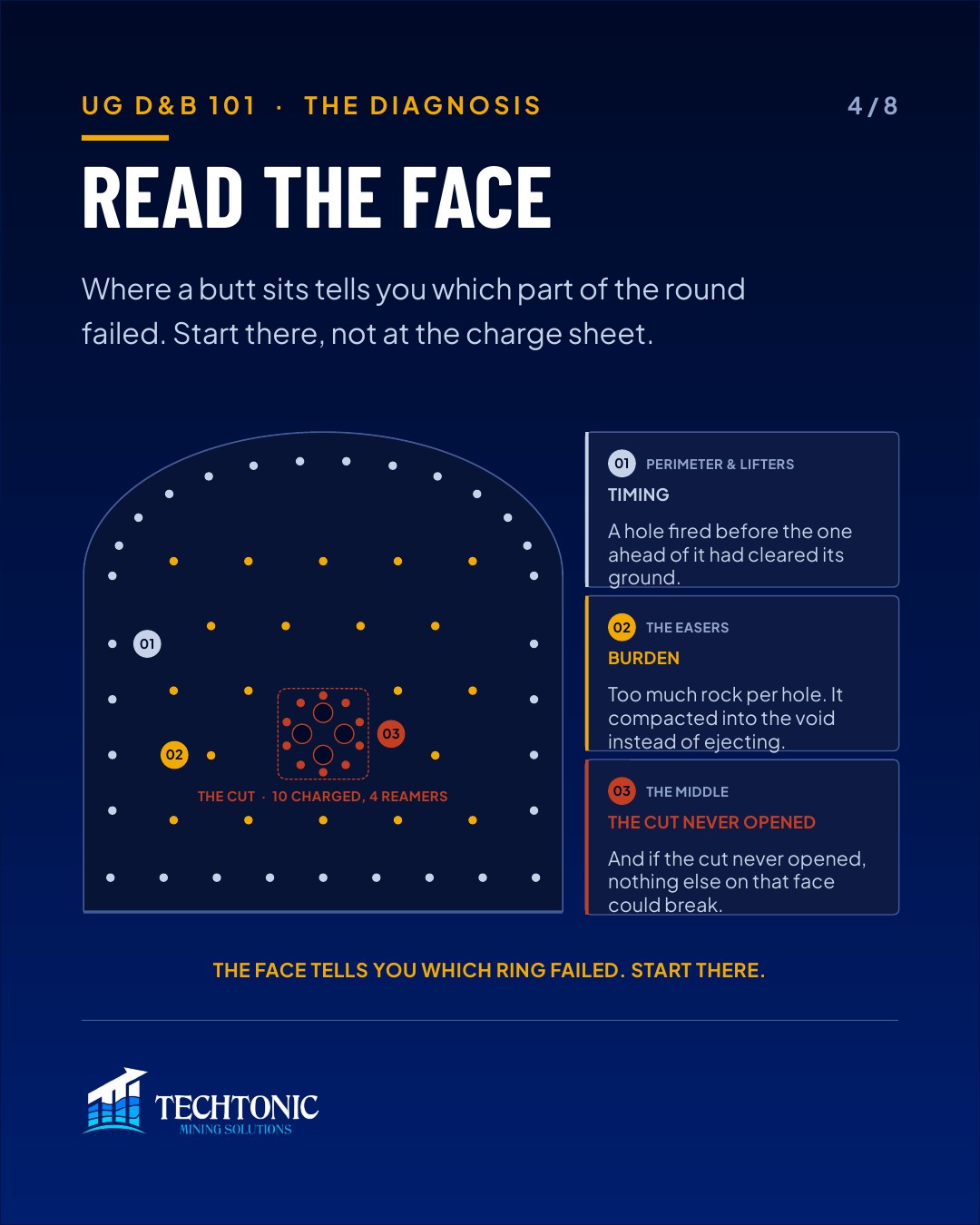
Where a butt sits tells you which part of the round failed. Start there, not at the charge sheet.
- Out on the perimeter and lifters — a timing problem. A hole fired before the one ahead of it had cleared its ground.
- In the easers — a burden problem. Too much rock per hole, and it compacted into the void instead of ejecting.
- Through the middle — the burn cut never opened, and if the cut never opened, nothing else on that face was ever going to break.
Suspect one: timing
Every hole or ring has to fire into the one ahead of it in the sequence: the cut, then the easers, then the perimeter, then the lifters. Too short a delay and the next ring fires into rock that has not moved, so it chokes. Too long and the ground has slumped back into the void it was meant to use. A delay window is not a formality; it is the whole mechanism.
Suspect two: burden
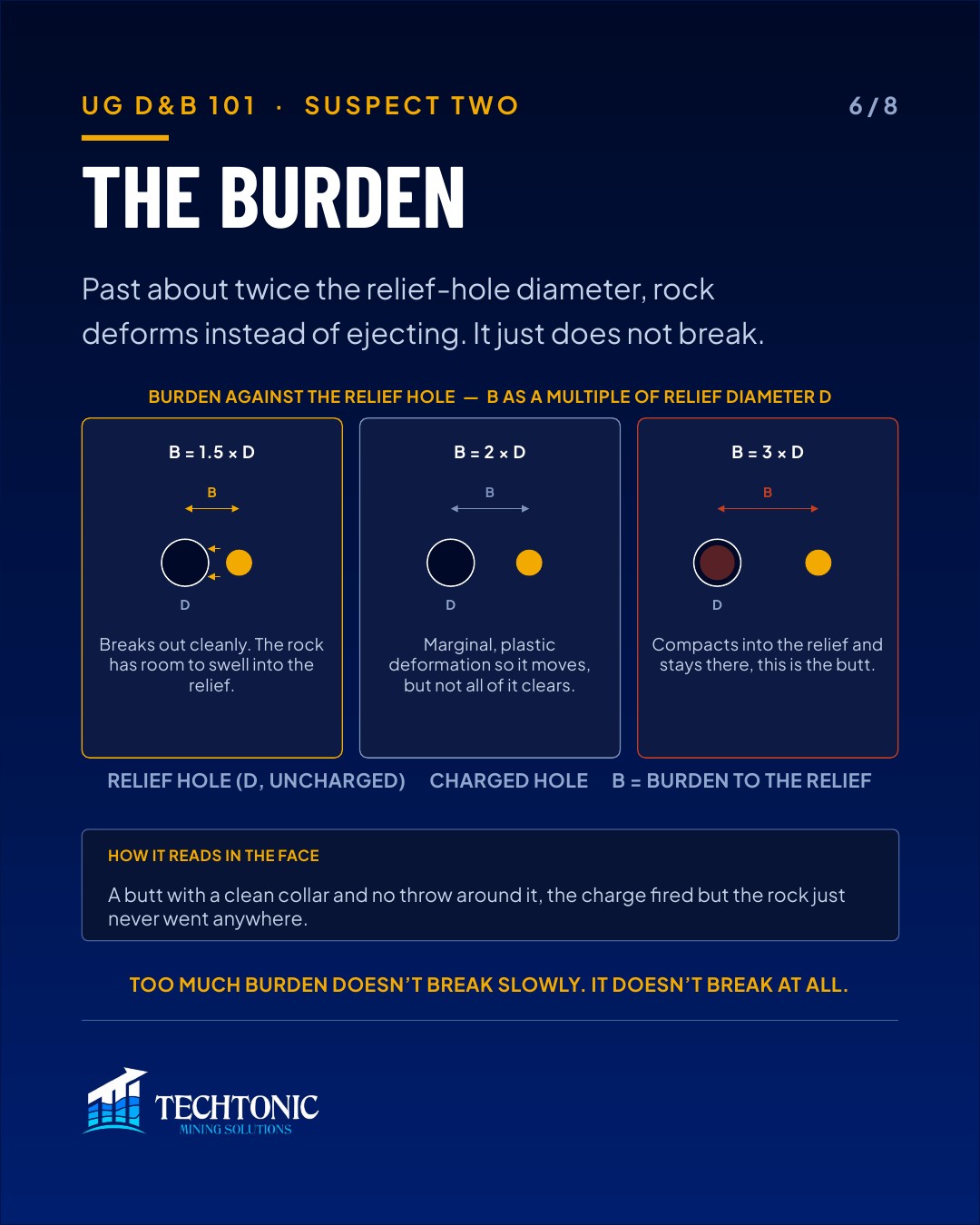
Past about twice the relief-hole diameter, rock deforms instead of ejecting. At 1.5 times the diameter it breaks out cleanly; at twice it is marginal; at three times it compacts into the relief and stays there. That is the butt — a clean collar with no throw around it, where the charge fired but the rock never went anywhere.
The usual culprit: the burn
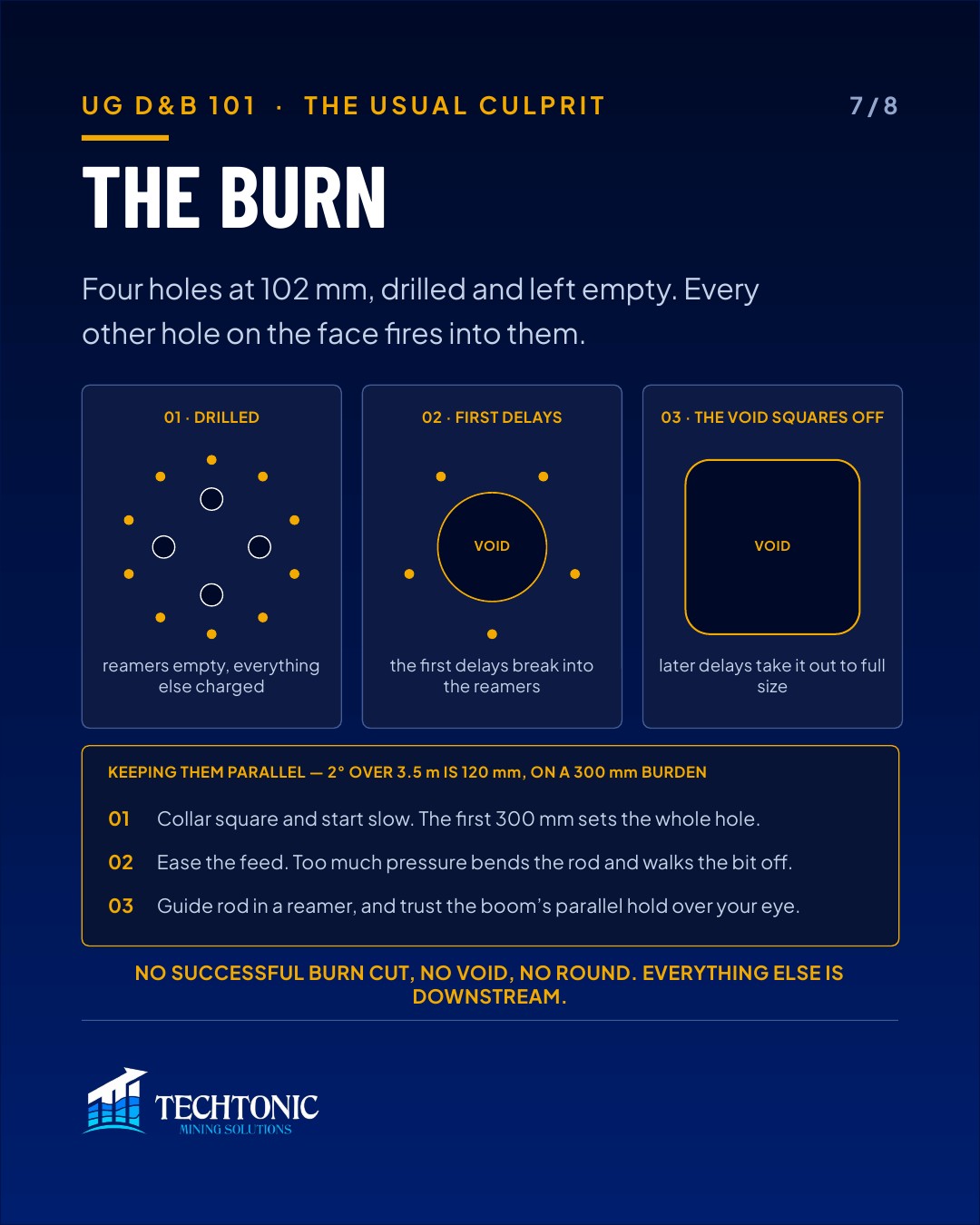
Four holes at 102 mm, drilled and left empty, and every other hole on the face fires into them. Keeping them parallel is the whole job: two degrees off over 3.5 m is 120 mm, on a 300 mm burden. Collar square and start slow, because the first 300 mm sets the whole hole. Ease the feed so the rod does not bend and walk the bit off line. Use a guide rod in a reamer, and trust the boom’s parallel hold over your eye.
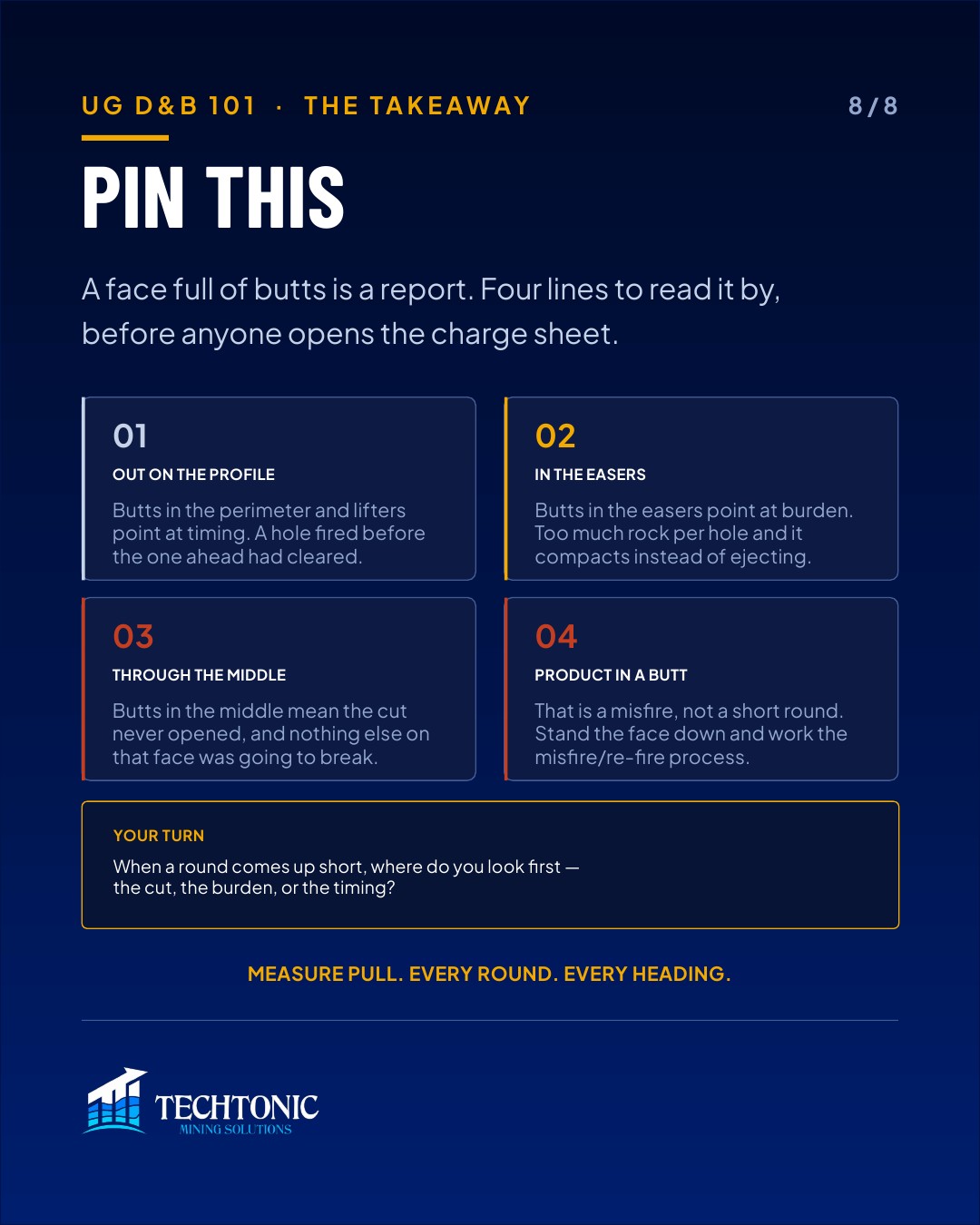
Pin this
A face full of butts is a report. Read it before anyone opens the charge sheet — and measure pull, every round, every heading.
When a round comes up short, where do you look first: the cut, the burden, or the timing?
The carousel
This piece began as a LinkedIn carousel. The full deck is below — use the arrows, or click any slide to enlarge.