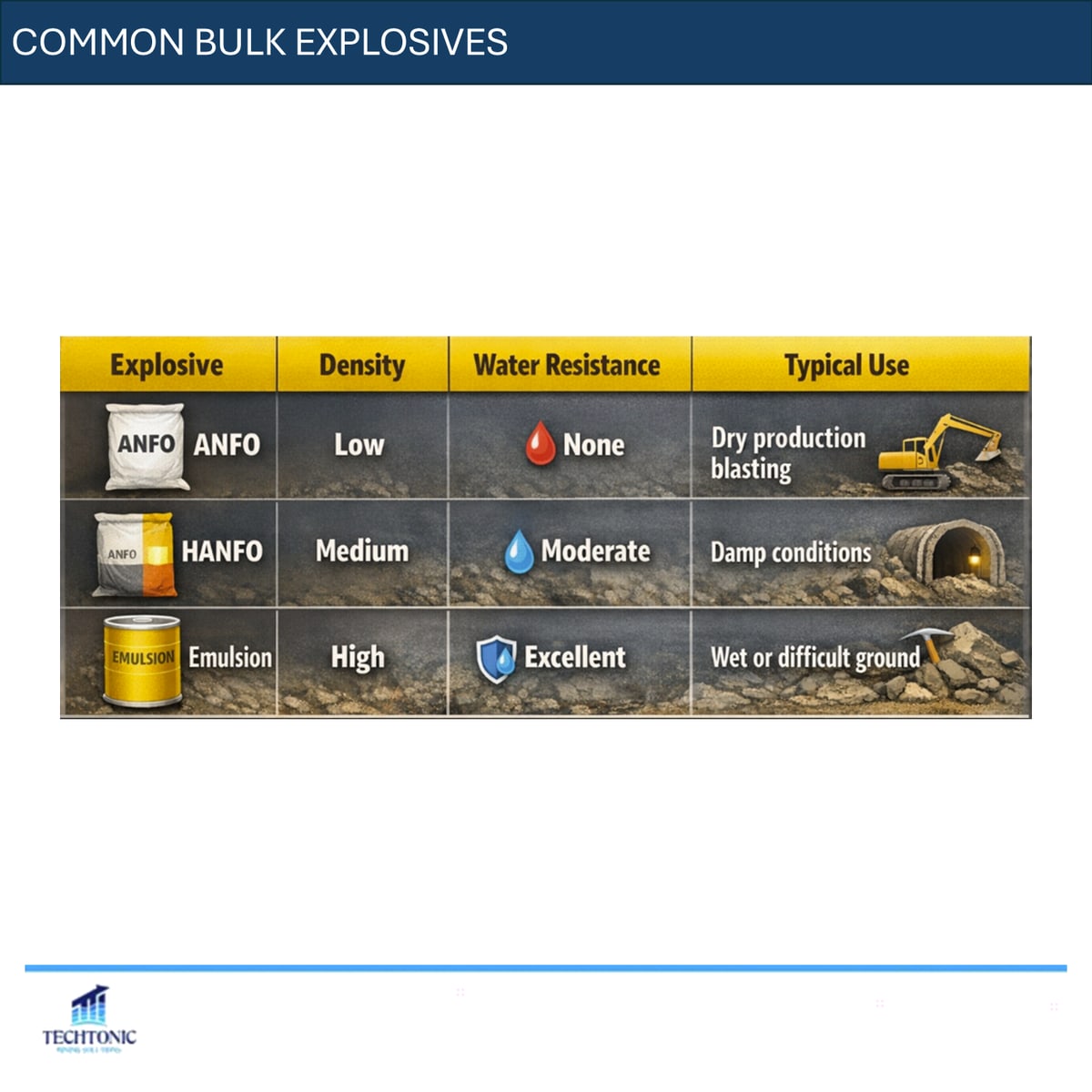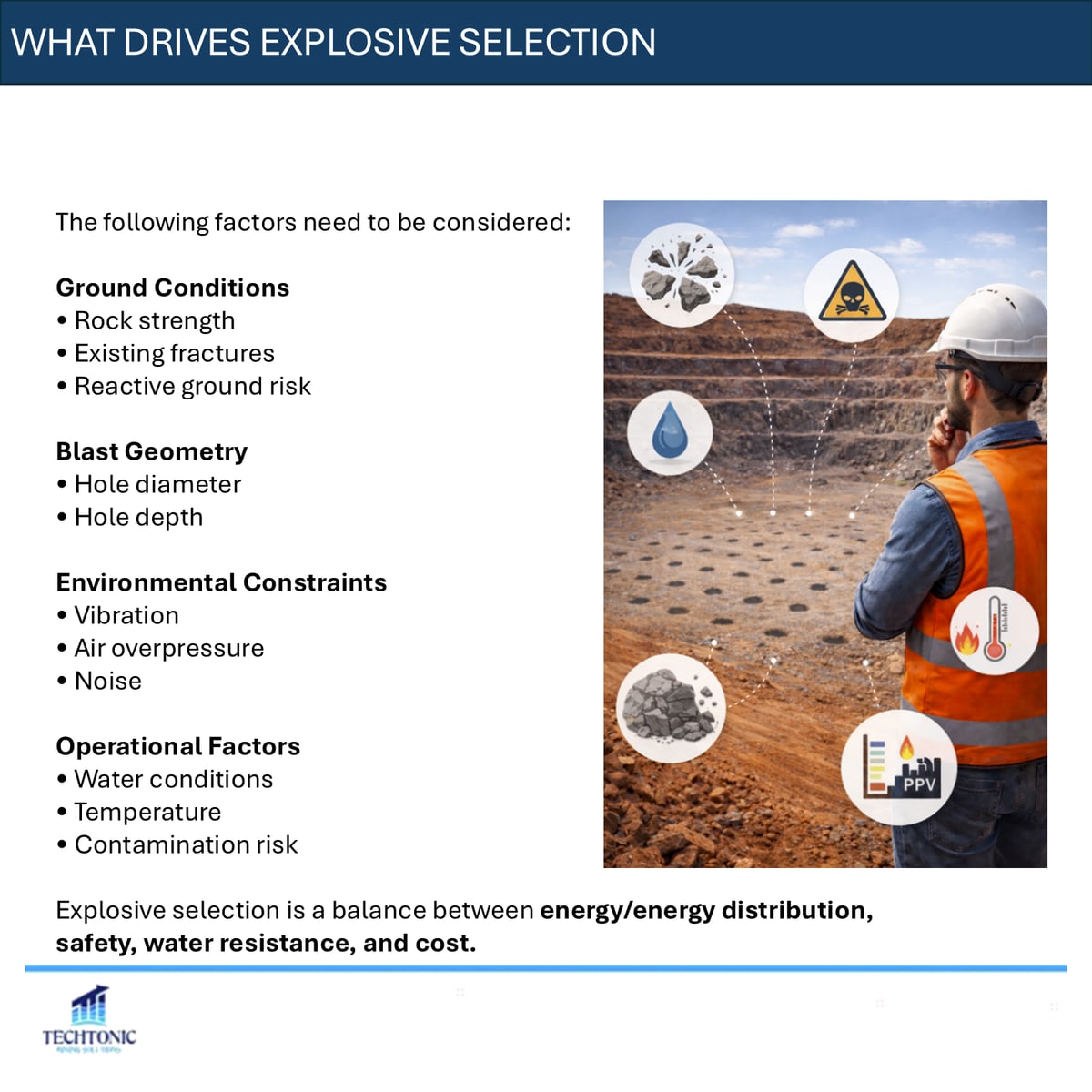
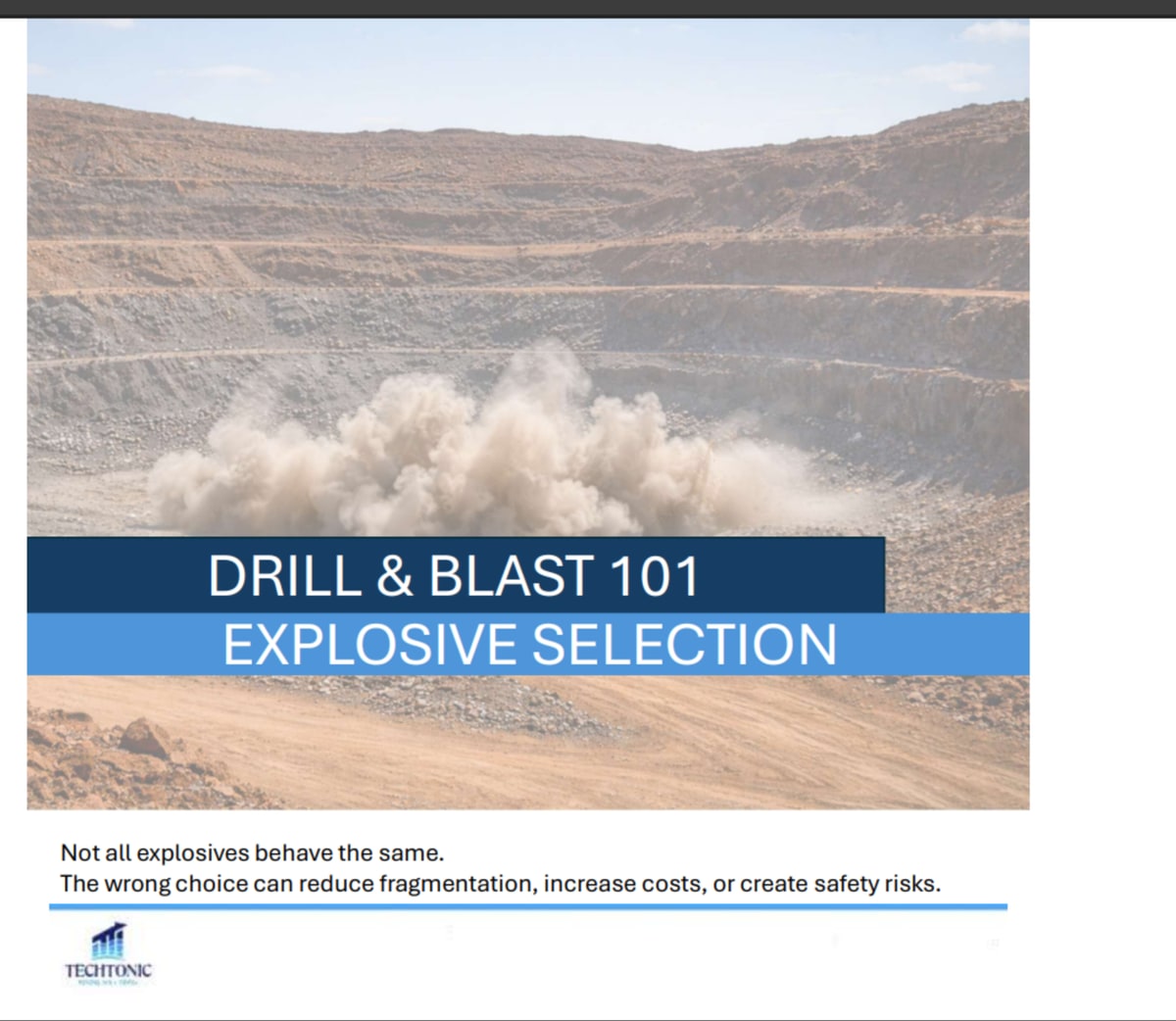
Not all explosives behave the same way, and the wrong choice will cost you fragmentation, add cost, or create a safety problem. Selection is always a balance between energy and how that energy is distributed, water resistance, safety, and price.
Four things drive the decision. Ground conditions: rock strength, existing fractures, and whether you are in reactive ground. Blast geometry: hole diameter and depth. Environmental constraints: vibration, air overpressure, noise. And operational factors: water, temperature, and contamination risk.
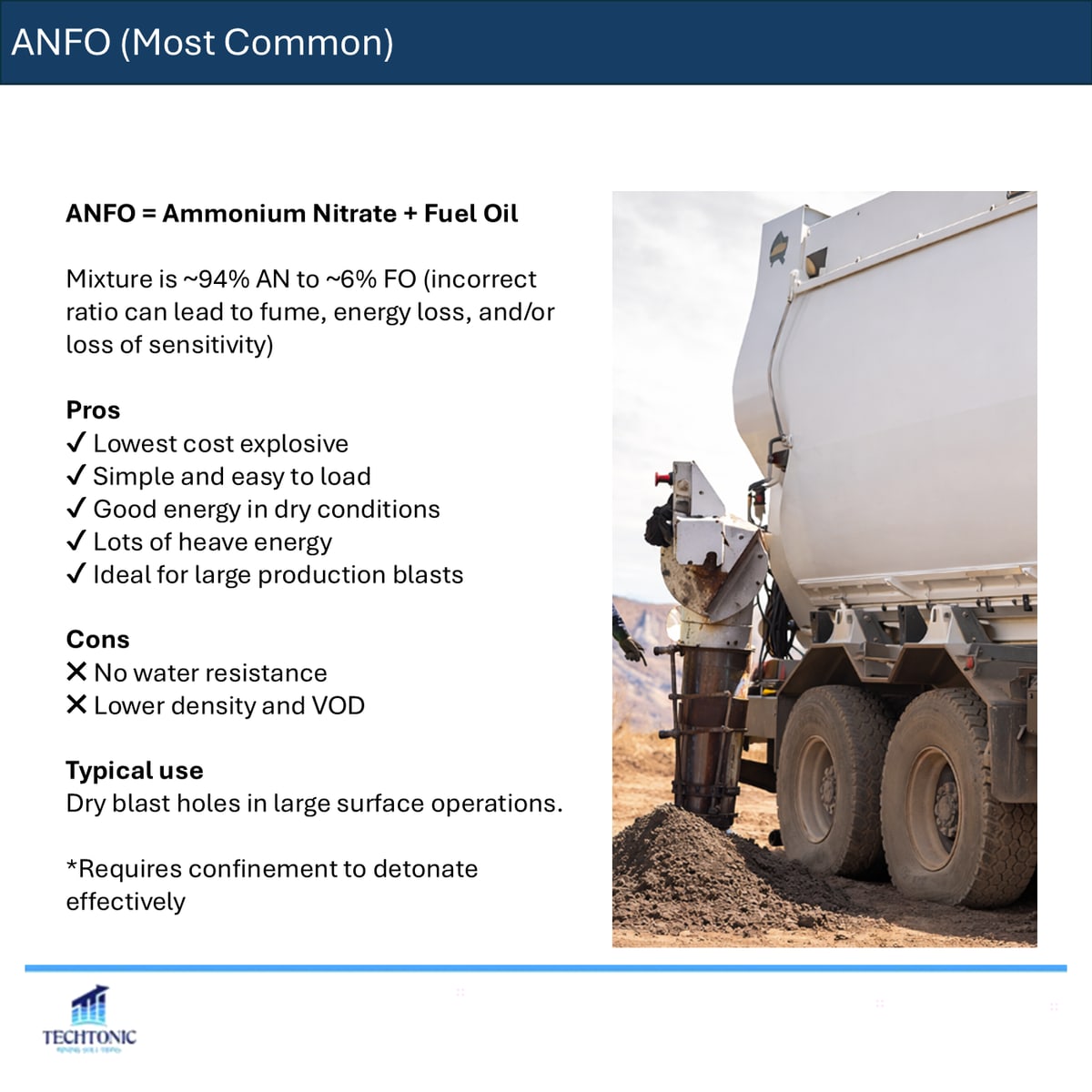
ANFO
Ammonium nitrate and fuel oil, blended at roughly 94% AN to 6% FO. That ratio matters more than it often gets credit for — get it wrong and you can end up with fume, energy loss, or a product that has lost sensitivity.
It is the cheapest option, simple to load, and produces plenty of heave energy, which makes it the default for large dry production blasts. It has no water resistance at all, and lower density and velocity of detonation (VOD) than the alternatives. It also needs confinement to detonate properly.
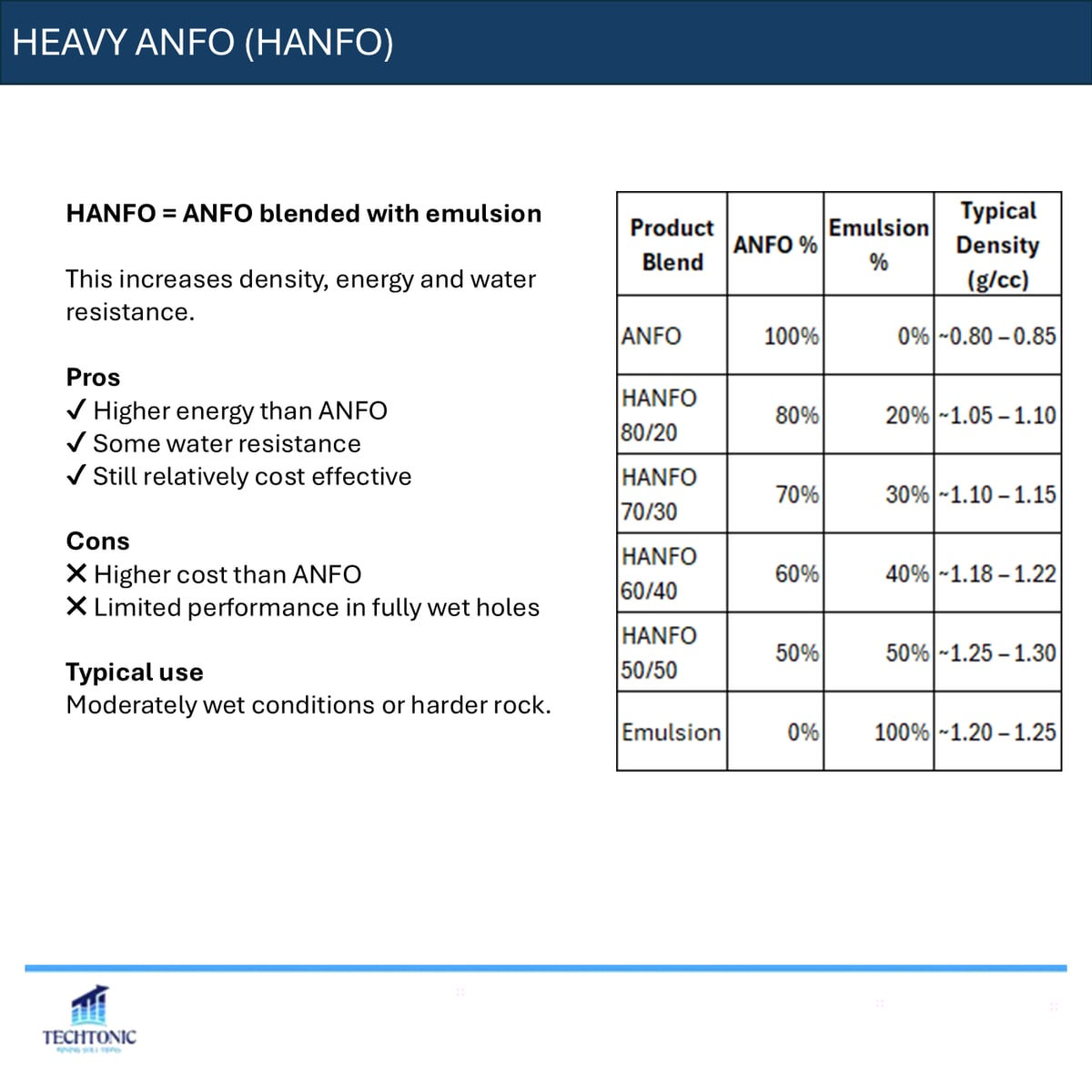
Heavy ANFO
ANFO blended with emulsion, which lifts density, energy and water resistance while staying reasonably cost effective. It suits moderately wet conditions and harder rock.
It costs more than straight ANFO and it will not save you in a fully wet hole. Heavy ANFO is a middle option, and it is worth being honest about which end of the middle your conditions sit at.
Emulsion
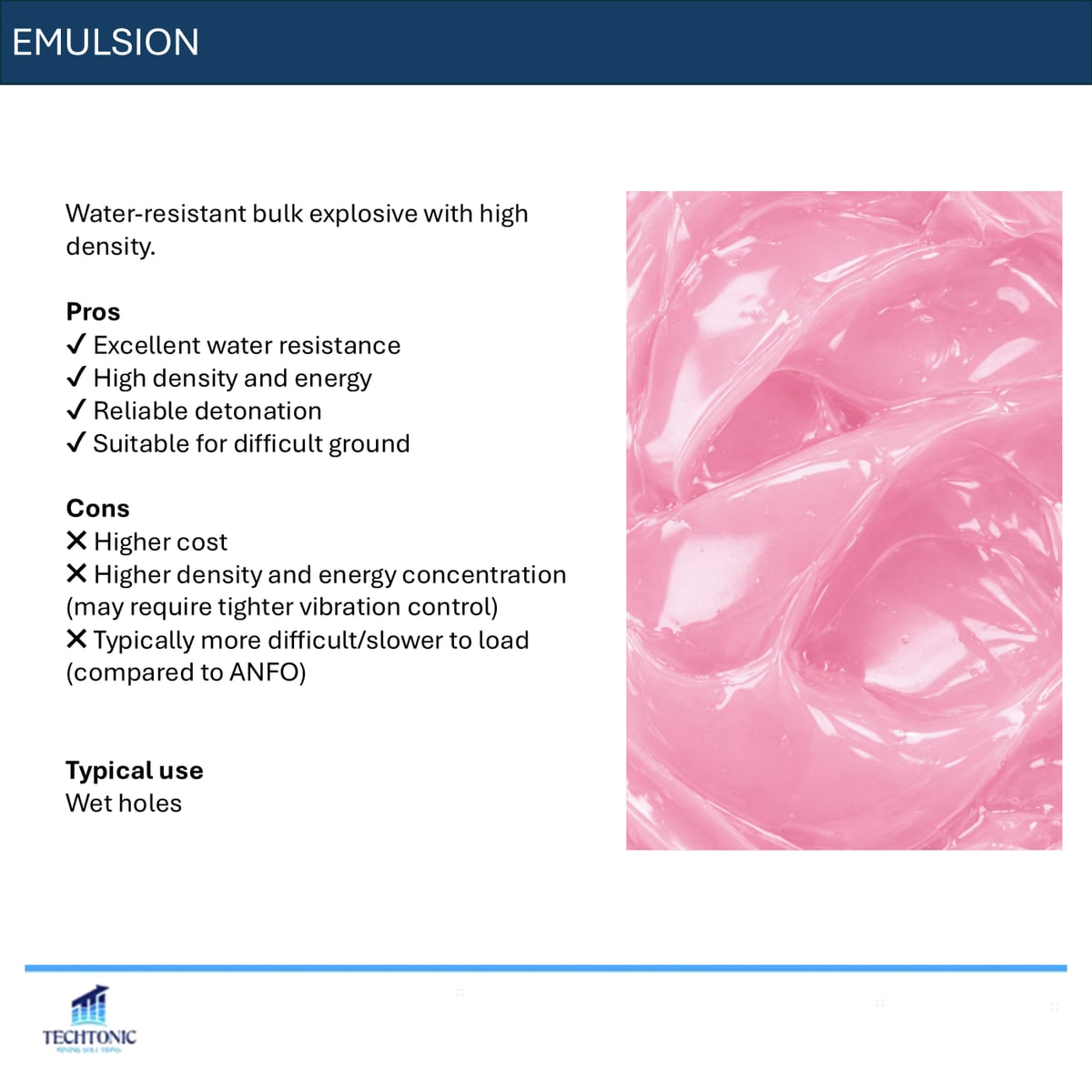
High density, genuinely water resistant, and reliable to detonate in difficult ground. Where there is water, this is usually the answer.
The trade-offs are cost, slower and more difficult loading than ANFO, and a higher energy concentration that may force tighter vibration control than you would otherwise need.
Ground that makes the decision for you
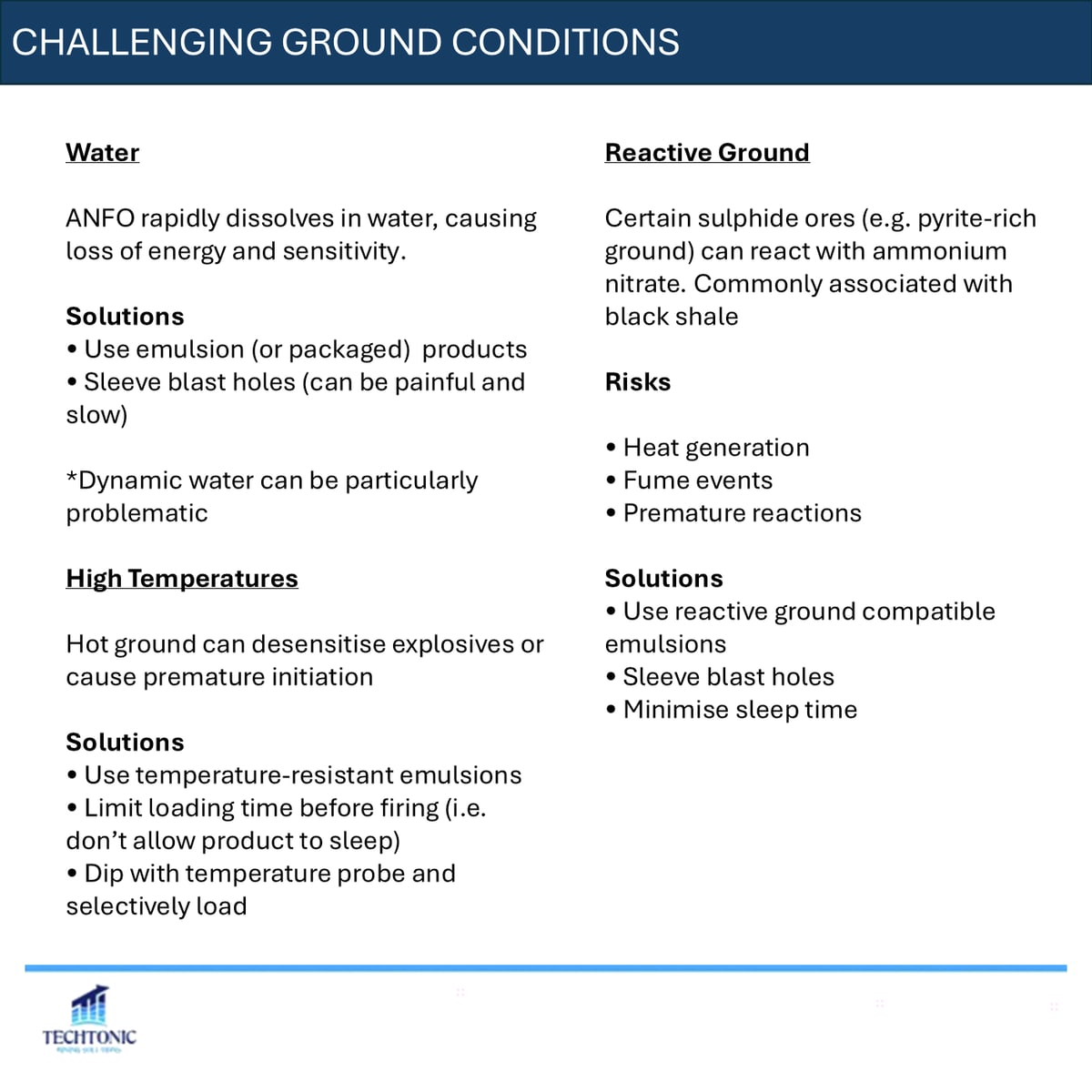
Water. ANFO dissolves rapidly in water, losing both energy and sensitivity. The options are emulsion or packaged products, or sleeving the holes, which is slow and painful but sometimes the only choice. Dynamic water — water moving through the ground rather than sitting in the hole — is particularly problematic.
High temperatures. Hot ground can desensitise explosives or cause premature initiation. Use temperature-resistant emulsions, limit the time between loading and firing (do not let product sleep), and dip with a temperature probe so you can load selectively.
Reactive ground. Some sulphide ores, particularly pyrite-rich ground and commonly black shale, react with ammonium nitrate. The risks are heat generation, fume events and premature reaction. Use a compatible emulsion, sleeve the holes, and keep sleep time to a minimum.
Density
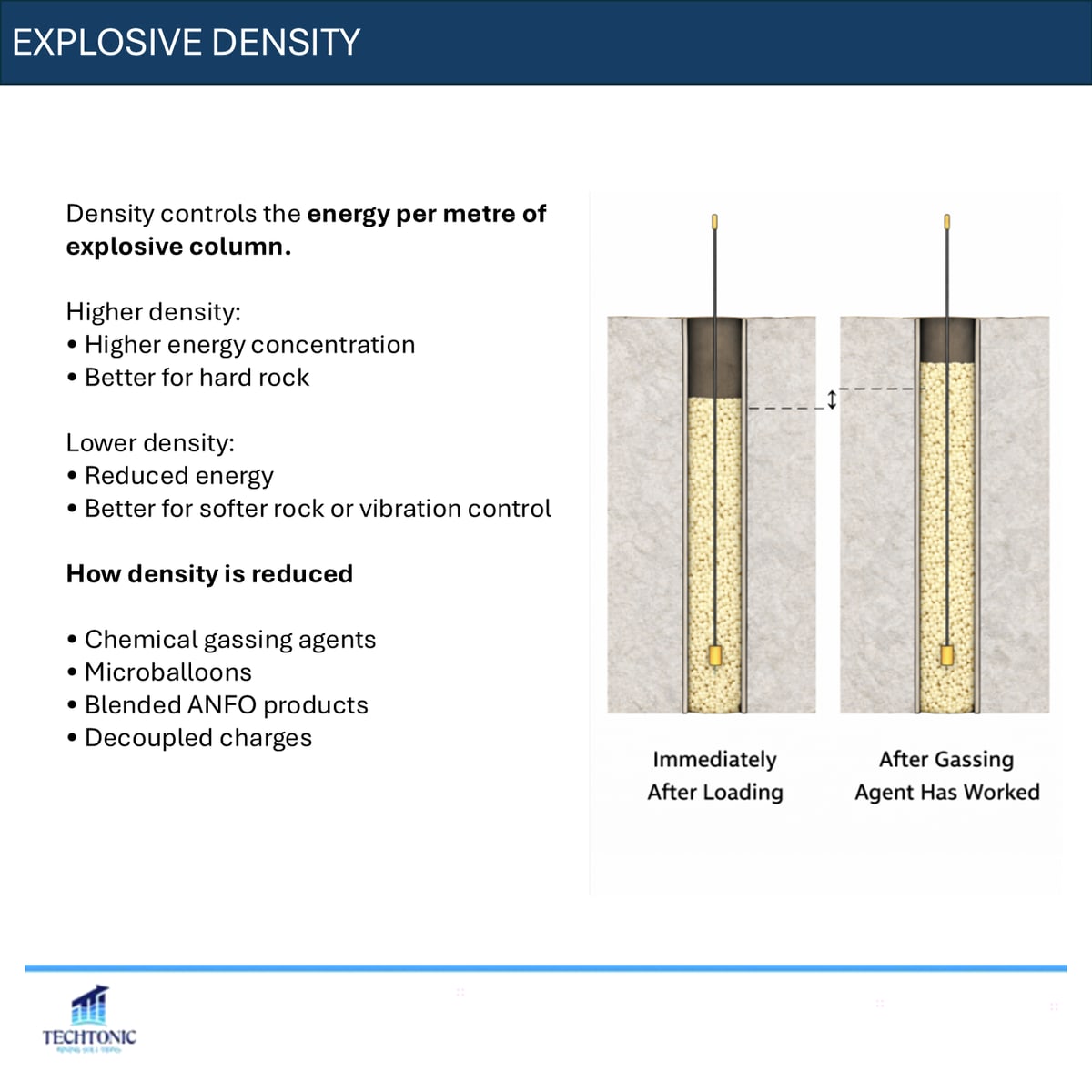
Density controls energy per metre of explosive column. Higher density concentrates energy and suits hard rock. Lower density reduces energy, which is what you want in softer rock or where vibration is the binding constraint.
Density is reduced through chemical gassing agents, microballoons, blended ANFO products, or by decoupling the charge.
There is no universal explosive
The right product depends on ground conditions, water, what the blast is trying to achieve, the environmental constraints you are operating under, and cost. Those five rarely point the same direction, which is the whole reason this is a decision rather than a default.
Get it right and it shows up well beyond the shot: better fragmentation, better dig rates, better crusher performance, and fewer environmental problems to manage.
How often does your explosive selection get reviewed against the ground you are actually in?
The carousel
This piece began as a LinkedIn carousel. The full deck is below — use the arrows, or click any slide to enlarge.