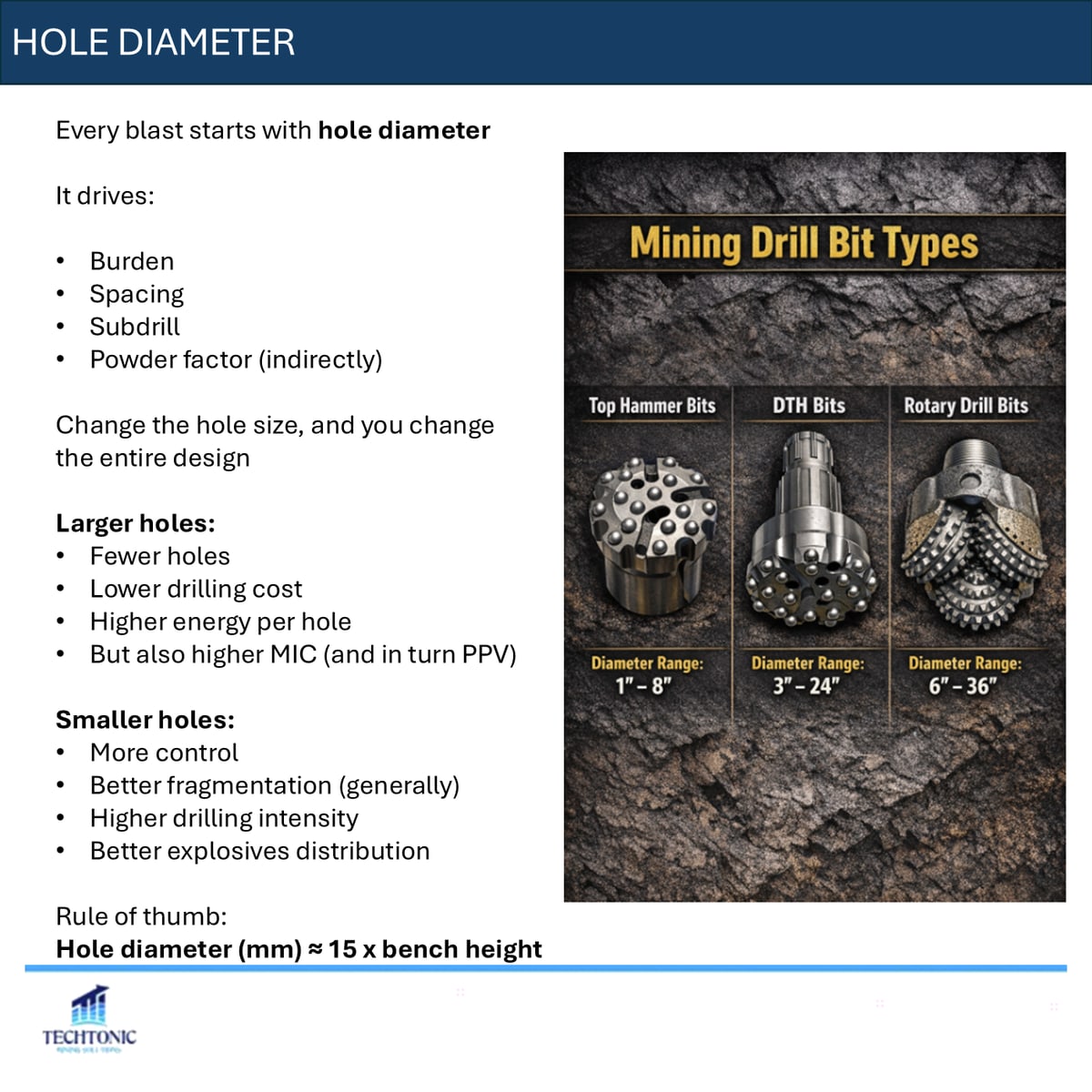
Every blast starts with hole diameter. Change it and you have changed the entire design, because burden, spacing, subdrill and powder factor all follow from it. It is also the variable you are least likely to be able to change once an operation is running, since it is set by the fleet you already own.
Larger holes mean fewer of them, lower drilling cost, and more energy per hole. They also mean a higher maximum instantaneous charge (MIC), and with it higher peak particle velocity (PPV). Smaller holes give you more control, better explosive distribution and generally better fragmentation, at the cost of drilling more metres.
As a starting point, hole diameter in millimetres is roughly 15 times bench height in metres. Like every rule of thumb here, it is a place to begin, not an answer.
Burden
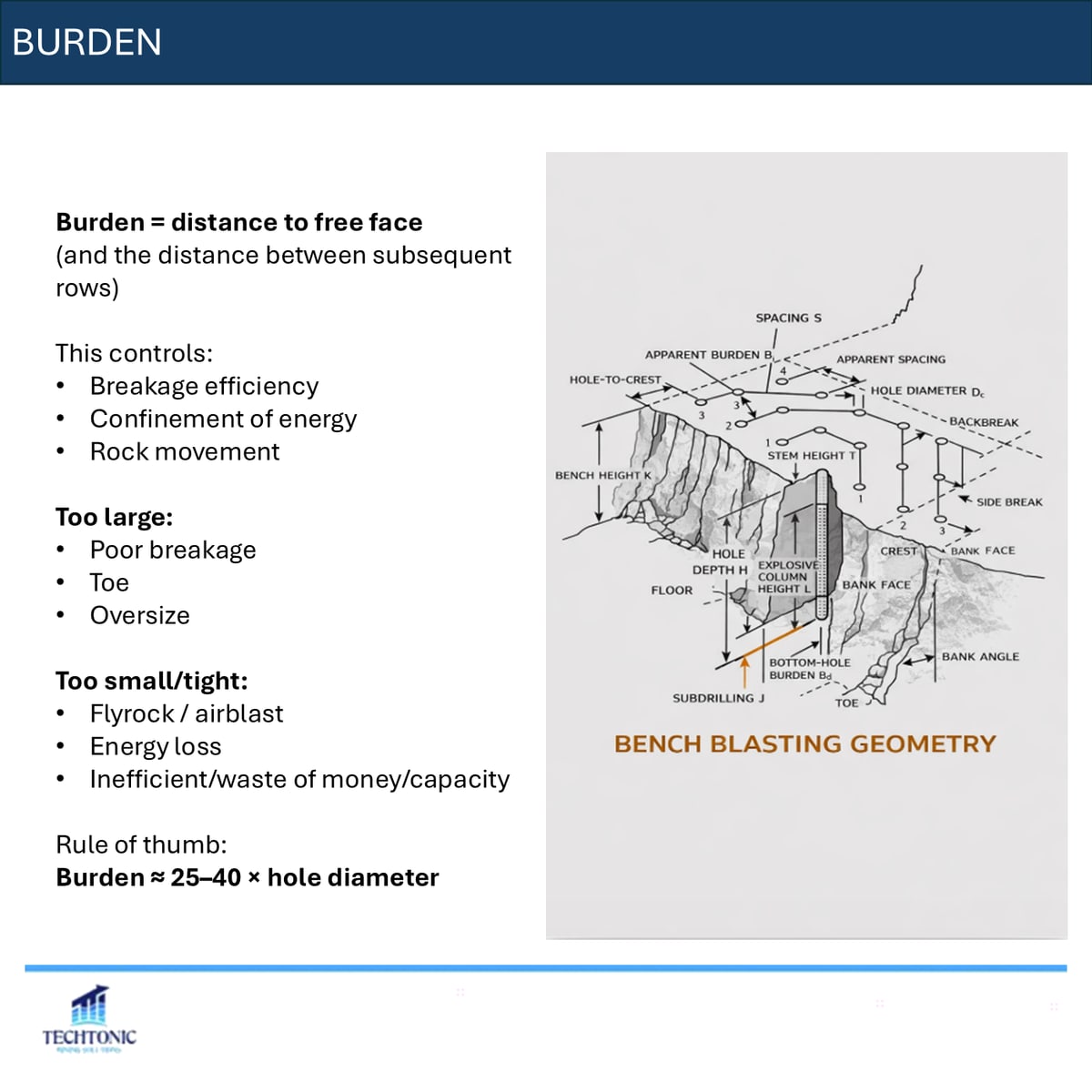
Burden is the distance to the free face, and thereafter the distance between rows. It controls breakage efficiency, how well the energy stays confined, and how the rock moves.
Too large and the energy has more rock than it can break: you get toe, oversize, and poor breakage generally. Too tight and the energy takes the easy path out of the face instead of into the rock, which shows up as flyrock and airblast, and as money spent on explosives that did no work.
Burden is typically 25 to 40 times hole diameter.
Spacing
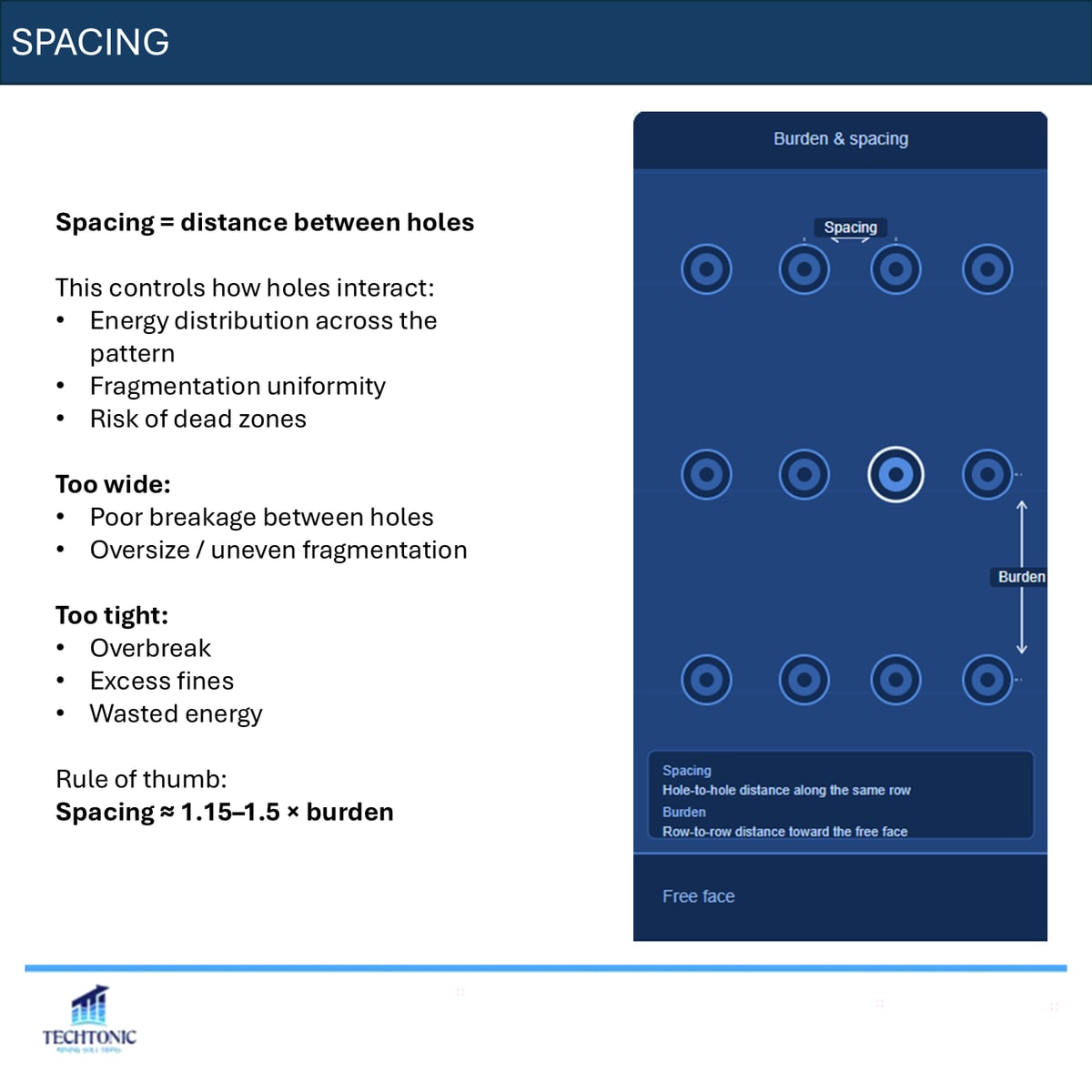
Spacing is the distance between holes in a row, and it governs how the holes interact with each other rather than how each one performs alone. Get it right and energy is distributed evenly across the pattern. Get it wrong in either direction and you see it in the muckpile.
Too wide leaves poor breakage between holes, oversize and uneven fragmentation. Too tight causes overbreak, excess fines and wasted energy.
Spacing usually runs at 1.15 to 1.5 times burden.
Why patterns are staggered
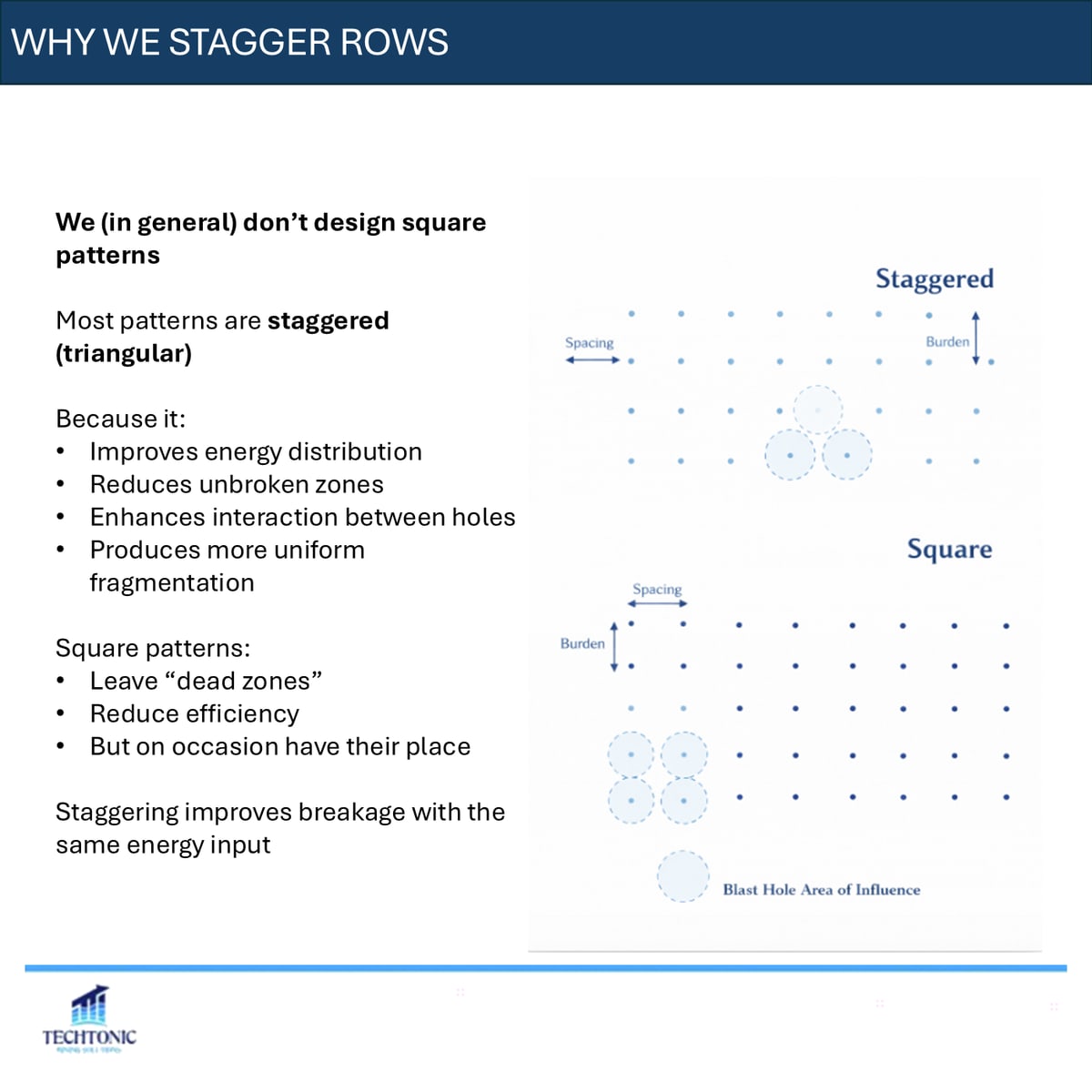
Most production patterns are staggered rather than square, and the reason is straightforward: a triangular arrangement distributes energy better, improves how adjacent holes interact, and reduces the unbroken zones that square patterns leave between holes.
Square patterns leave dead zones and are less efficient for the same energy input. They still have their place on occasion, but staggering gives better breakage without spending anything extra.
Subdrill
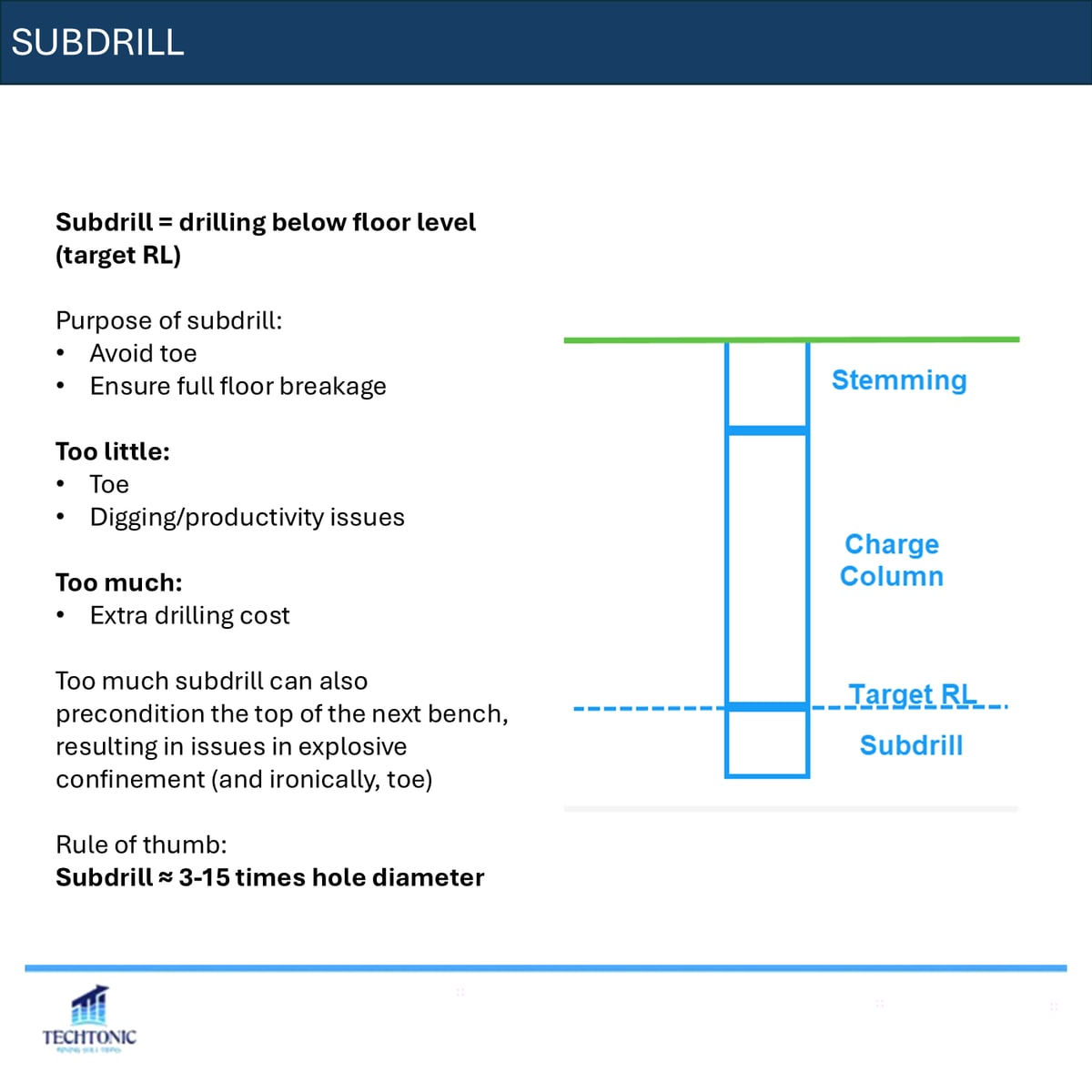
Subdrill is the depth drilled below the target floor level. Its job is to make sure the floor breaks properly rather than leaving toe for the diggers to fight.
Too little and you get toe, which becomes a digging and productivity problem. Too much and you are paying for metres you do not need — and, less obviously, you may precondition the top of the next bench down. That damages explosive confinement on the following shot, which ironically tends to produce toe again.
Subdrill generally sits somewhere between 3 and 15 times hole diameter, which is a wide range because the right answer depends heavily on the ground.
Angled holes
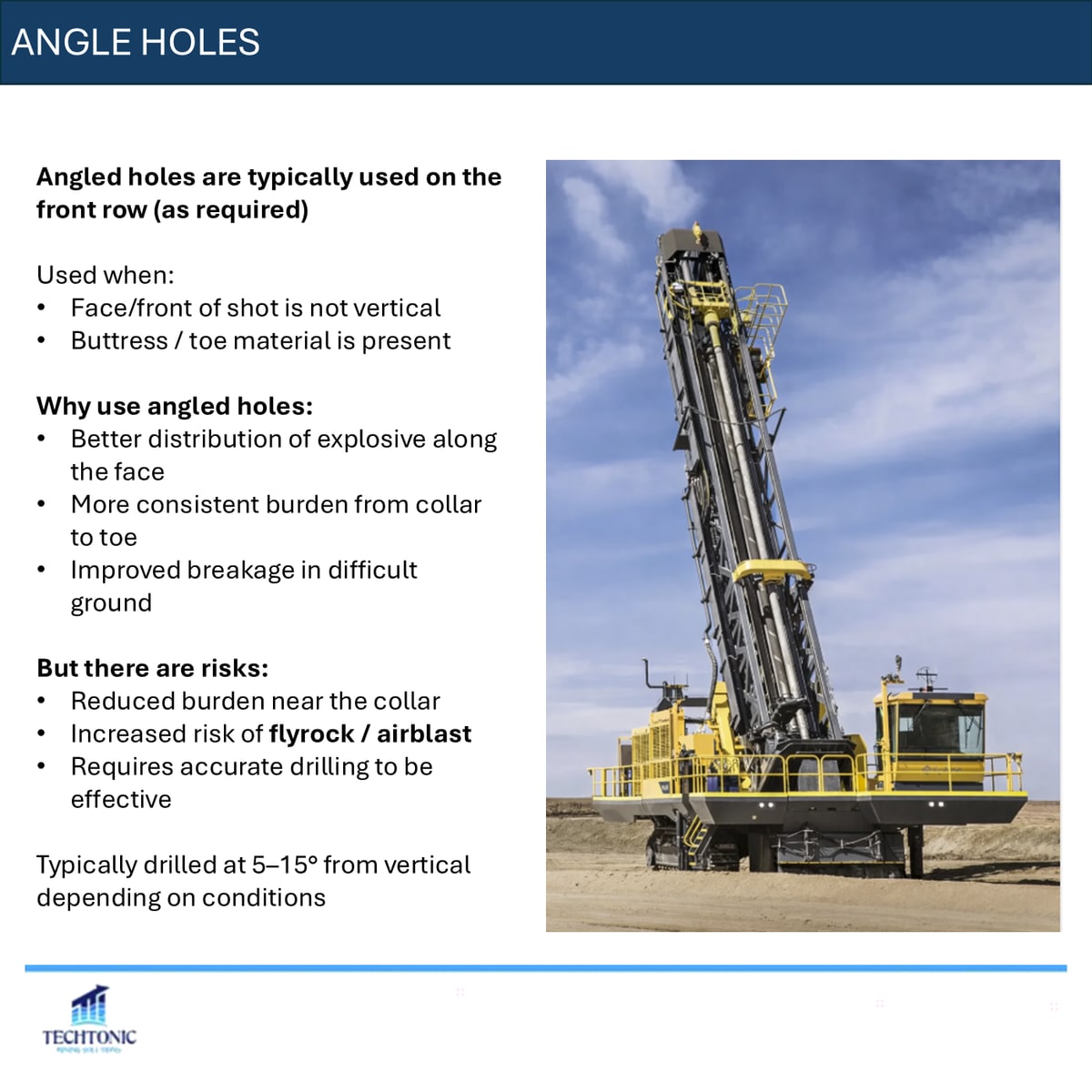
Angled holes are typically a front row tool, used when the face is not vertical or when there is buttress or toe material to deal with. Angling the holes distributes explosive more evenly down the face and keeps burden more consistent from collar to toe, which improves breakage in difficult ground.
They are not free. Angling reduces burden near the collar, which increases flyrock and airblast risk, and the whole benefit depends on the holes actually being drilled where the design says. Typical angles run 5 to 15 degrees off vertical depending on conditions.
These variables do not move independently
That is the part worth carrying away. You cannot adjust burden without affecting spacing, or add subdrill without thinking about the bench below, or change hole diameter without redesigning everything downstream of it.
Which is why, in practice, blasts are usually balanced rather than optimised. A pattern also has to serve the material movement it is feeding and the shots either side of it, and a design that is theoretically ideal in isolation can be the wrong one in sequence.
Good blasting starts with good design. Everything after it — charging, timing, initiation — is working with the geometry the drill pattern gave it.
When did you last review the rules of thumb your patterns are built on?
The carousel
This piece began as a LinkedIn carousel. The full deck is below — use the arrows, or click any slide to enlarge.