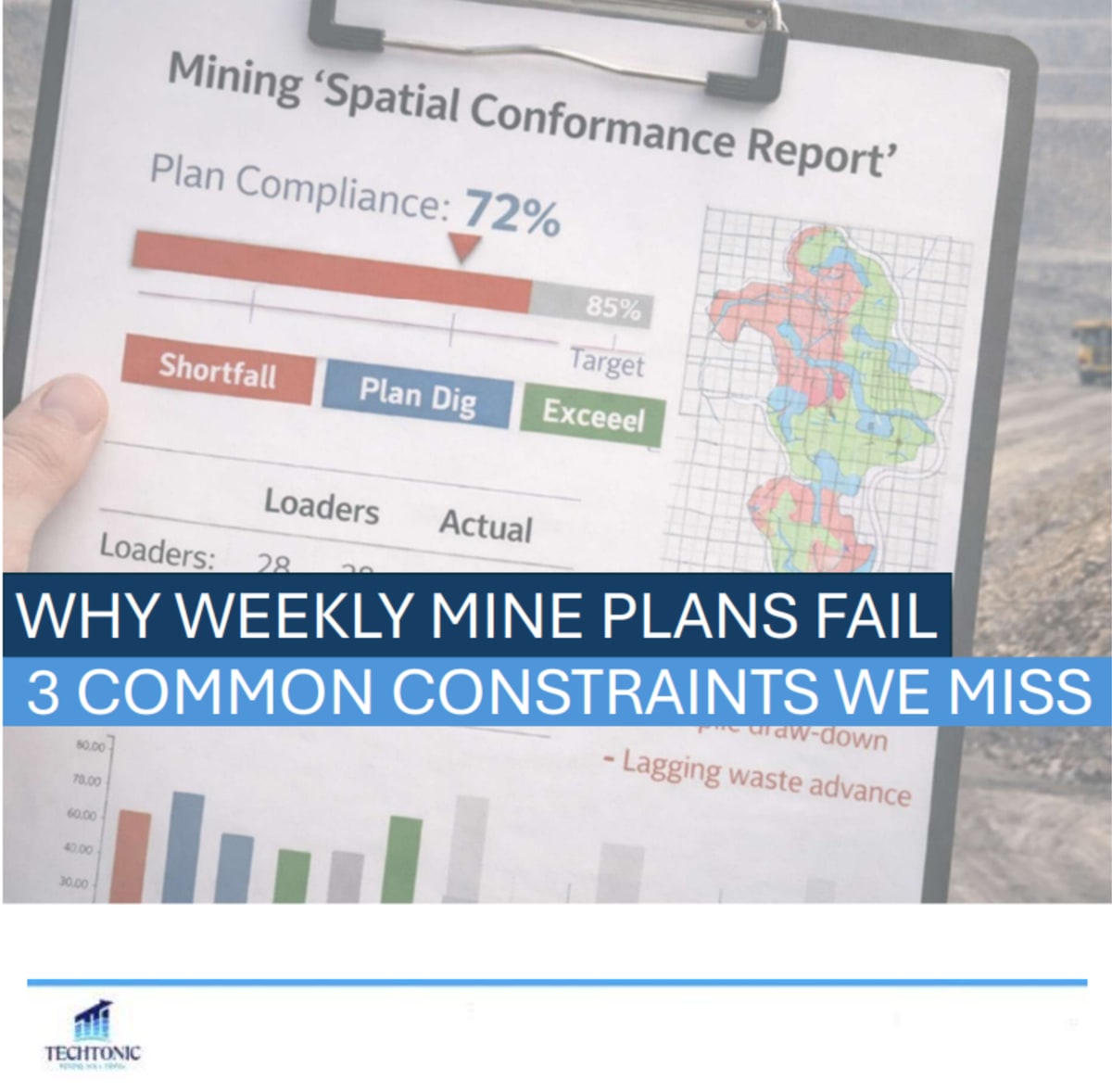
Weekly spatial compliance comes in under 80%, and the review meeting goes looking for a culprit. Usually it settles on geology not returning as expected, on the execution team deviating from plan, or on a run of bad luck.
Occasionally that is right. Mostly it isn’t.
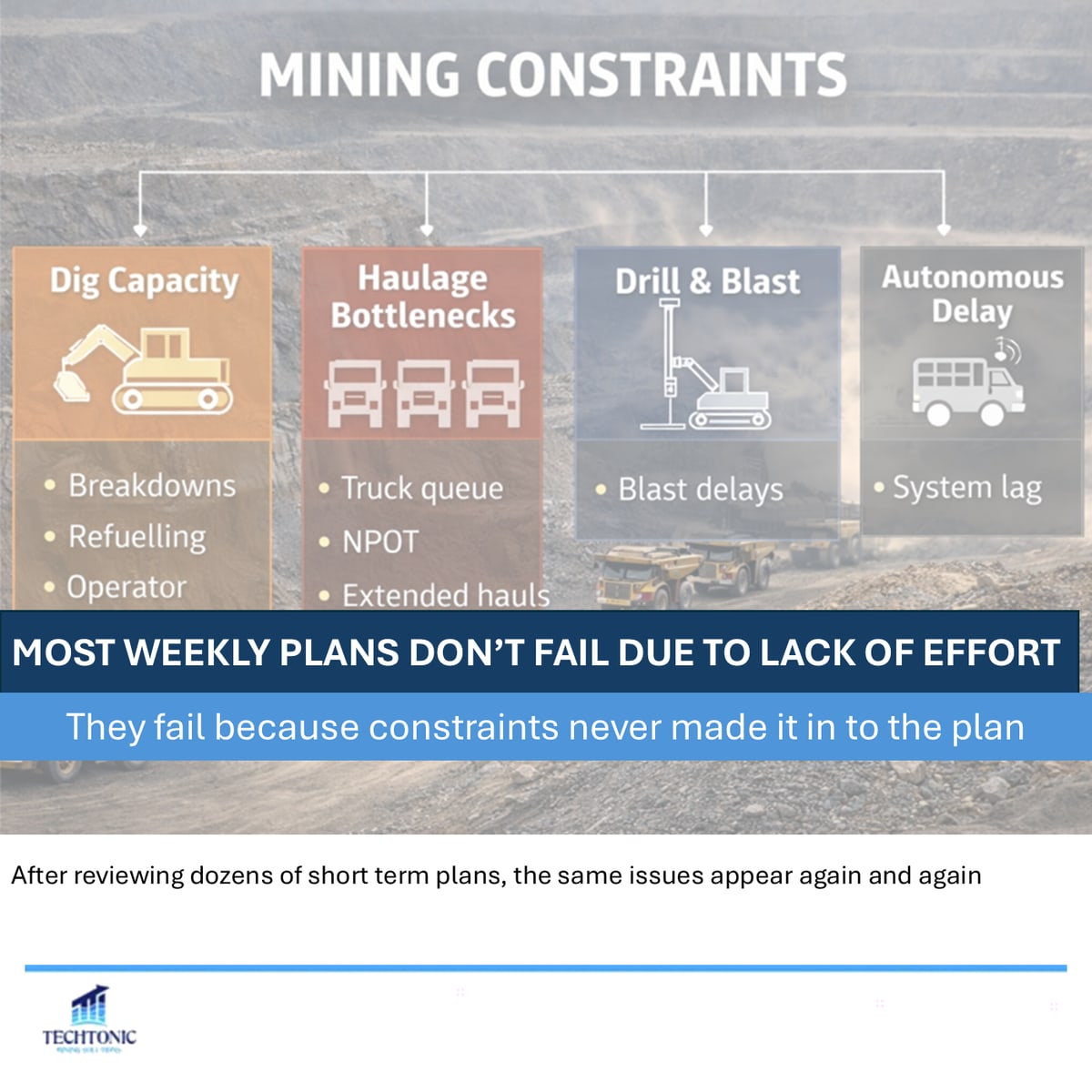
Across dozens of short-term plans we have reviewed on open pit operations, the same three constraints come up over and over. It is rare that the issue is genuinely an execution failure. Every one of them was true on site before the week started. They just never made it into the plan.
1. Dig capacity: real hours are not planned hours
Every weekly plan is built on an assumed number of dig hours. The question worth asking is where that number came from. Often it is last month’s average, or a figure that reflects what the operation is capable of on a good week rather than what it does on an ordinary one.
Then the shift runs. Breakdowns and unscheduled loss. Refuelling. Clean-ups. Relocations. Operator changeovers. Individually every one of them is defensible and none of them feel like a planning issue. Together they quietly remove two to three hours per shift.
That alone will destroy compliance, and it does it invisibly. The plan does not look wrong on Monday. It looks wrong on Friday, by which point the conversation has moved on to how to catch up.
The check is straightforward: take last week’s planned dig hours and put them next to the actual. Not the availability percentage, the hours. If there is a consistent gap in the same direction, you are not managing a performance problem. You are planning to a number the operation has never achieved.
2. Drill and blast timing misalignment
If the next block isn’t fired, or at least drilled, it has no business appearing in the first week of the plan.
This one is the easiest to spot and the most commonly ignored, because the assumption is usually reasonable in isolation. The block is scheduled to be fired midweek. The plan takes that at face value and sequences the dig behind it. What the plan does not carry is the drill and blast cycle’s own constraints, which have to line up before the shot can happen at all.
Assumed blast availability is not achievable blast availability. When the shot slips, the plan does not slip with it — it just stops being followable, and the crews are left choosing between the sequence and the material that is actually available.
Worth counting: of the blocks in last week’s plan, how many were unfired when the week began? If it is more than a couple, the plan was optimistic before anyone turned a wheel.
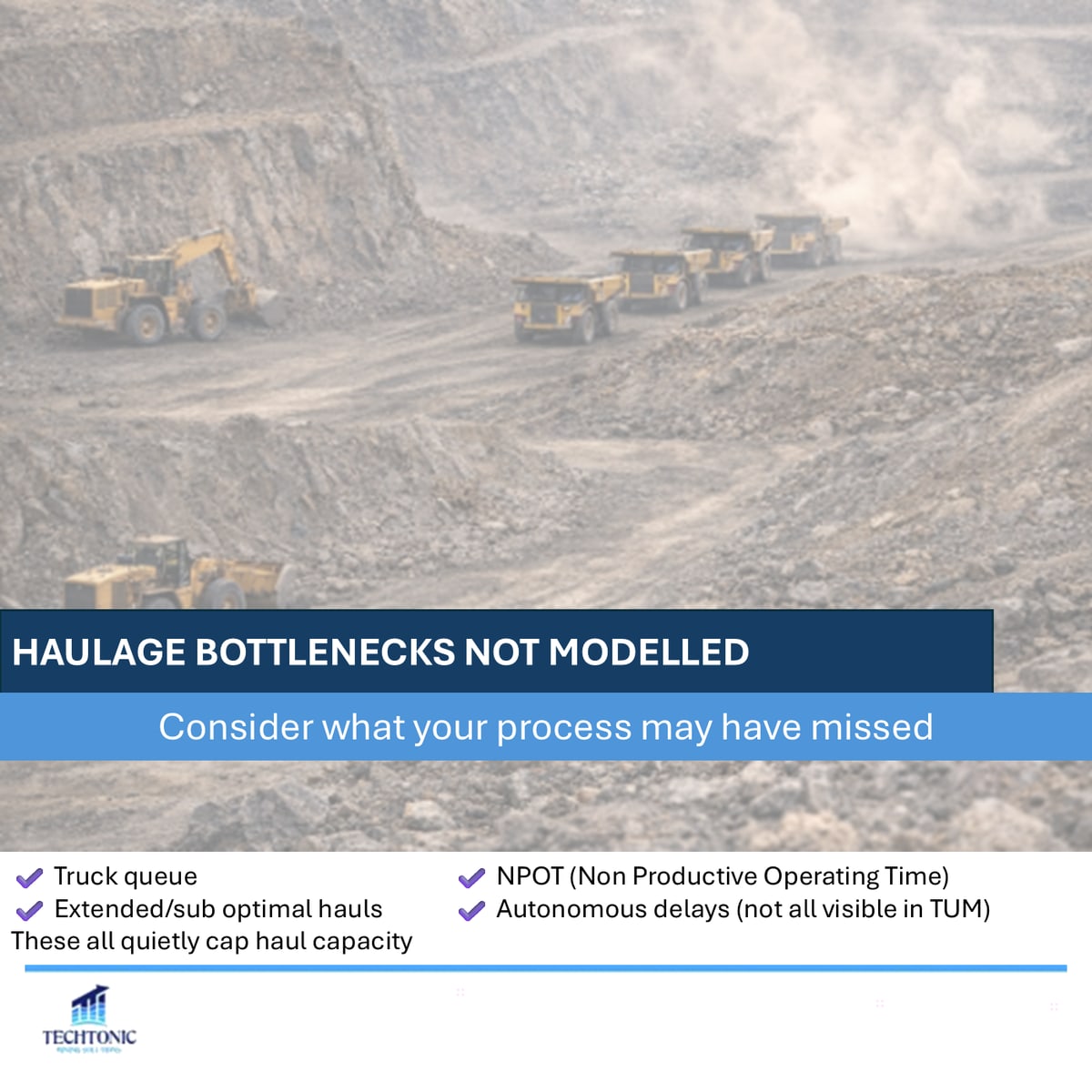
3. Haulage bottlenecks that were never modelled
Haulage is usually modelled as a rate. It behaves as a network.
Truck queueing at the shovel and at the dump. Extended or sub-optimal hauls where the road is not where the model thinks it is (it is rare for a planned haul network to be completely accurate or up to date). Non-productive operating time (NPOT). On autonomous fleets, delays that don’t show up in the Time Usage Model at all, because the TUM was never built to see them.
None of these announce themselves. They cap haul capacity quietly, and because they cap it below what the plan assumed, the shortfall gets attributed to whichever part of the operation is most visible that week.
What it costs
The result is predictable enough that you can usually name it before you see the numbers. TMM is missed. Stockpiles are pillaged. Rehandle goes up. The ore has to come from somewhere.
Rehandle is the one that hurts most, because it compounds. Capacity that should have moved new material goes into moving material you have already moved once, which puts you further behind, which generates more rehandle the following week. Two or three weeks of this and the operation is running to recover rather than to plan.
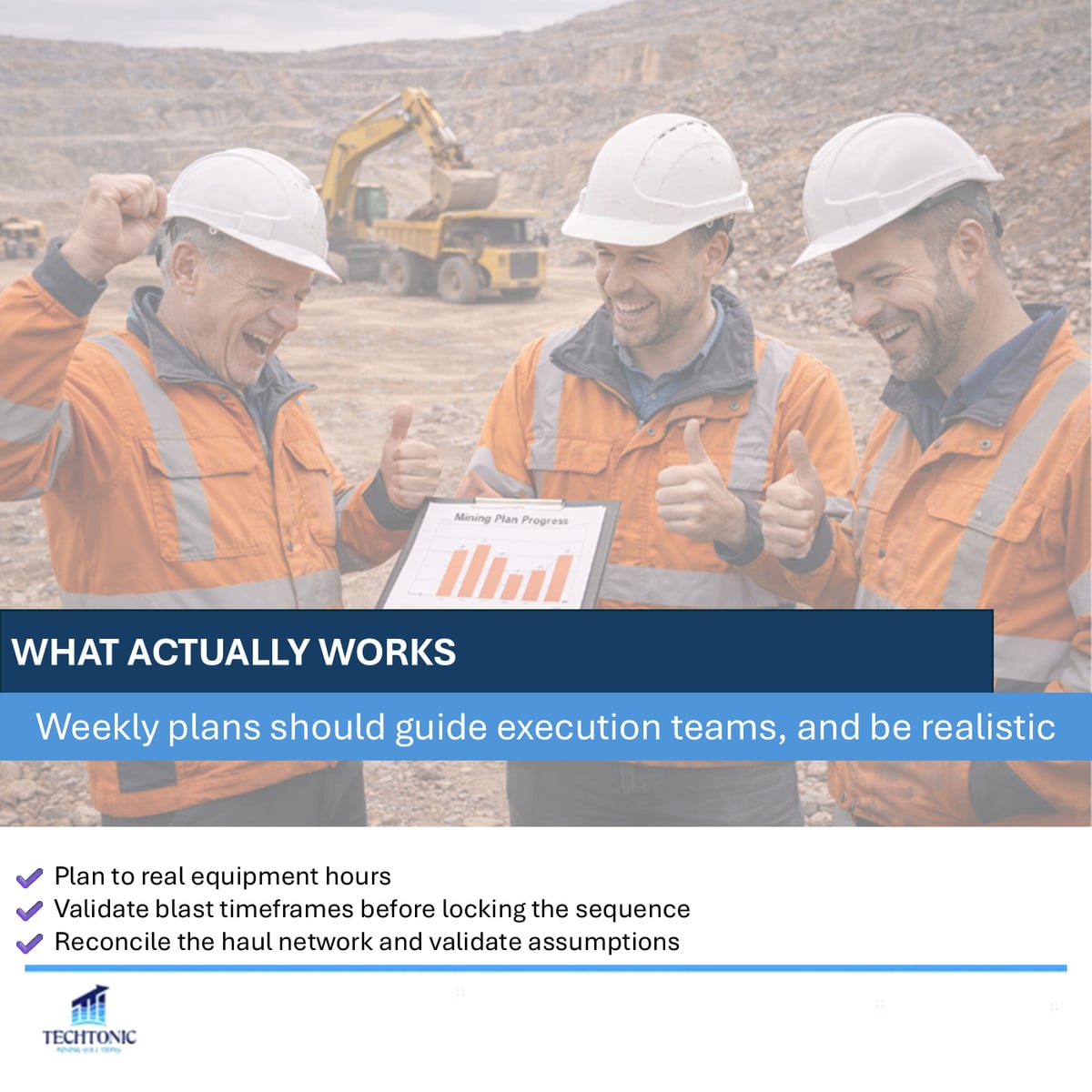
What actually works
Plan to real equipment hours. Be pragmatic rather than optimistic. A plan built on hours the operation genuinely delivers is worth more than an ambitious one nobody can follow, even if the tonnes look worse on paper.
Validate blast timeframes before locking the sequence. Only capture blocks with a high degree of certainty. A block that might be available is not a block you can dig.
Reconcile the haul network. Check the assumptions driving haul capacity against what the roads and the fleet are actually doing, and do it often enough that the model does not drift away from the pit.
Underneath all three is the same idea. A weekly plan is a production tool, not a reporting document. If it is written to be defensible in a meeting rather than followable on a shift, it will keep failing, and the failure will keep getting blamed on the people trying to execute it.
So if your weekly spatial compliance is sitting under 80%, it is probably not the geology. It is usually one of these three.
How close is your actual production to plan each week?
The carousel
This piece began as a LinkedIn carousel. The full deck is below — use the arrows, or click any slide to enlarge.