Most of a mine design is built with a handful of functions: project, offset, spline, trim and extend, transpose.
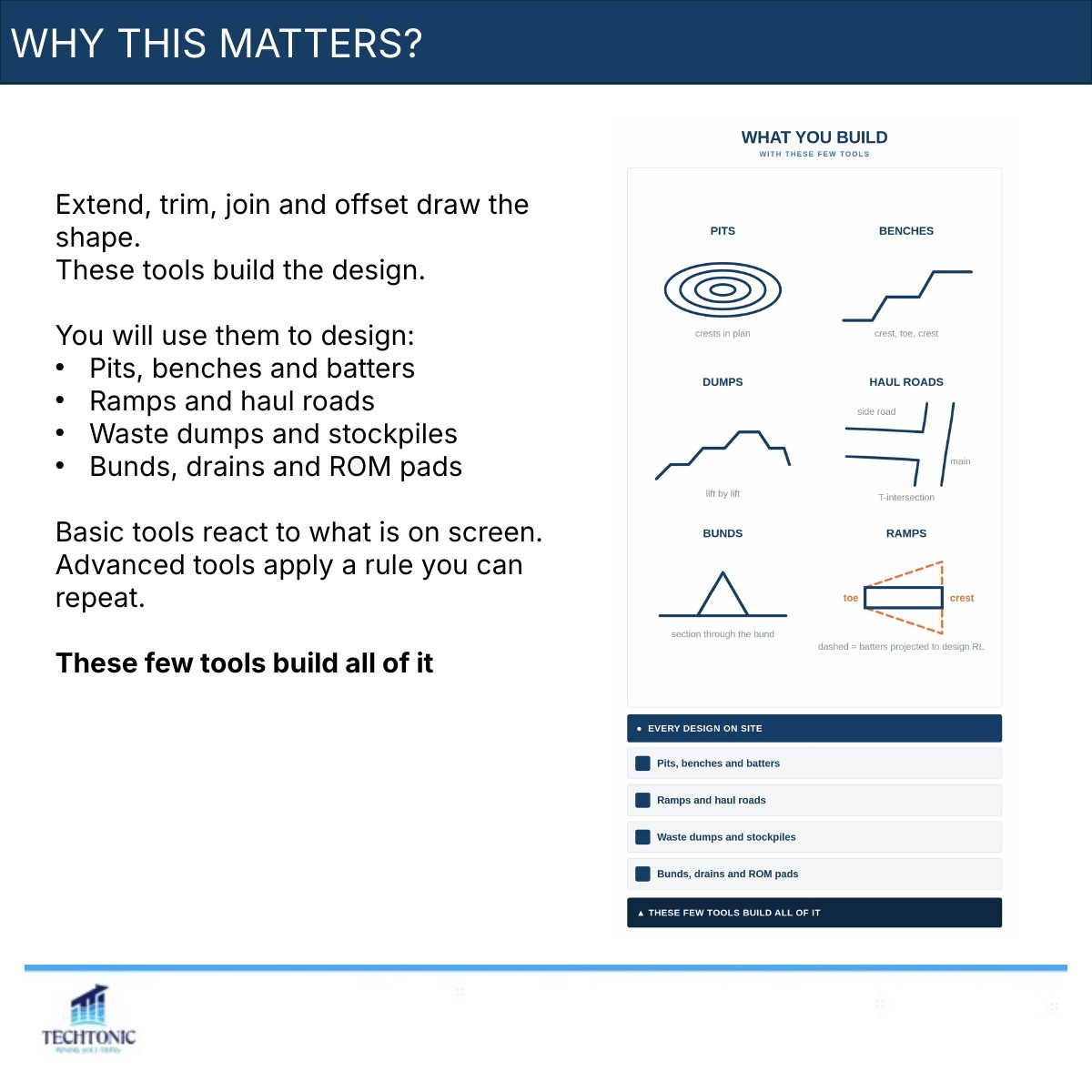
The difference is not speed. A design built from rules can be checked, repeated and handed to someone else. A design built by dragging vertices can only be redrawn. Basic tools react to what is on screen; advanced tools apply a rule you can repeat.
Pits, benches and batters. Ramps and haul roads. Waste dumps, stockpiles, bunds, drains and ROM pads. These few tools build all of it.
Project by angle and distance
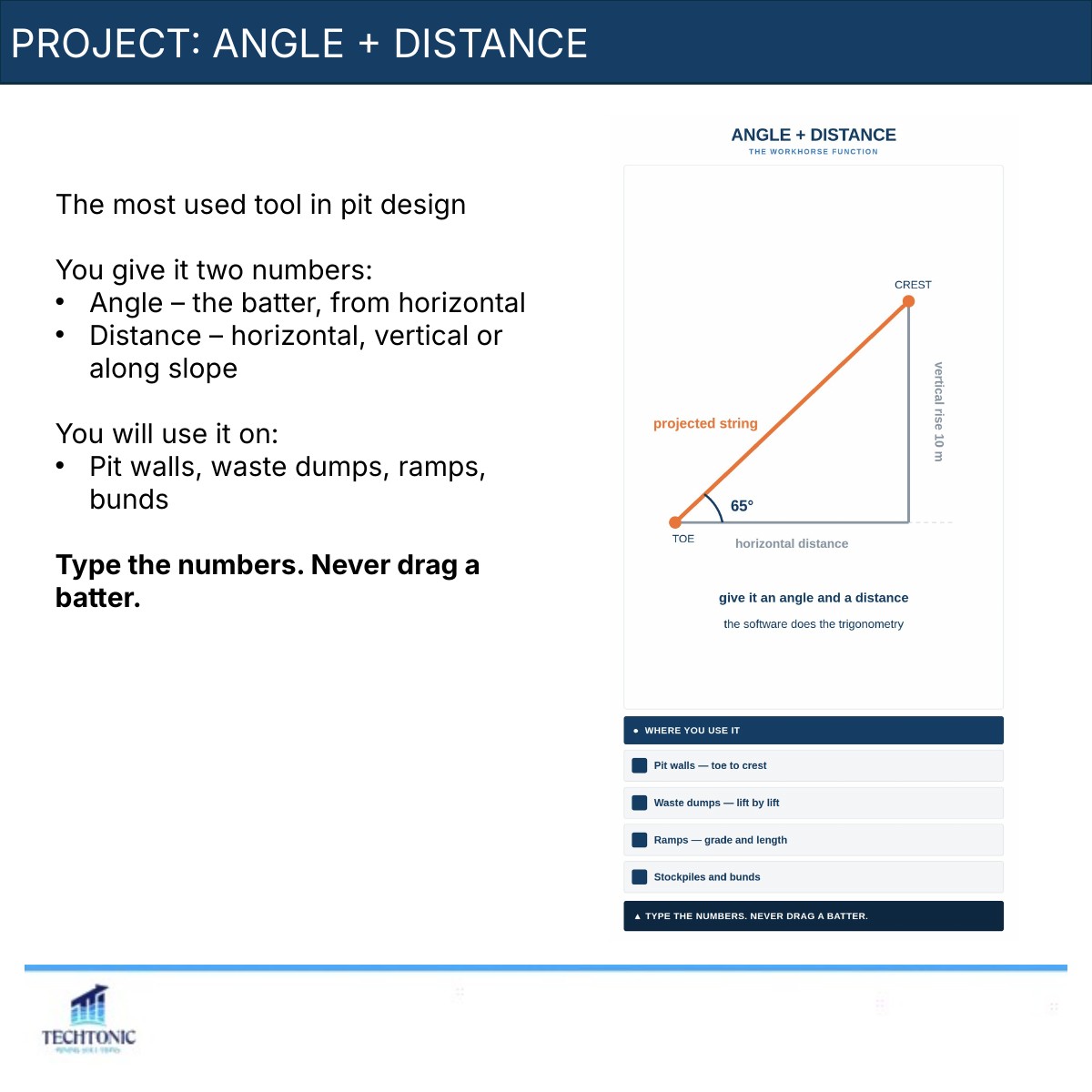
The most used tool in pit design. You give it two numbers: an angle, which is the batter measured from horizontal, and a distance, which can be horizontal, vertical or along slope. The software does the trigonometry.
Pit walls, waste dumps, ramps and bunds all start here. Type the numbers. Never drag a batter.
Offsets that build geometry
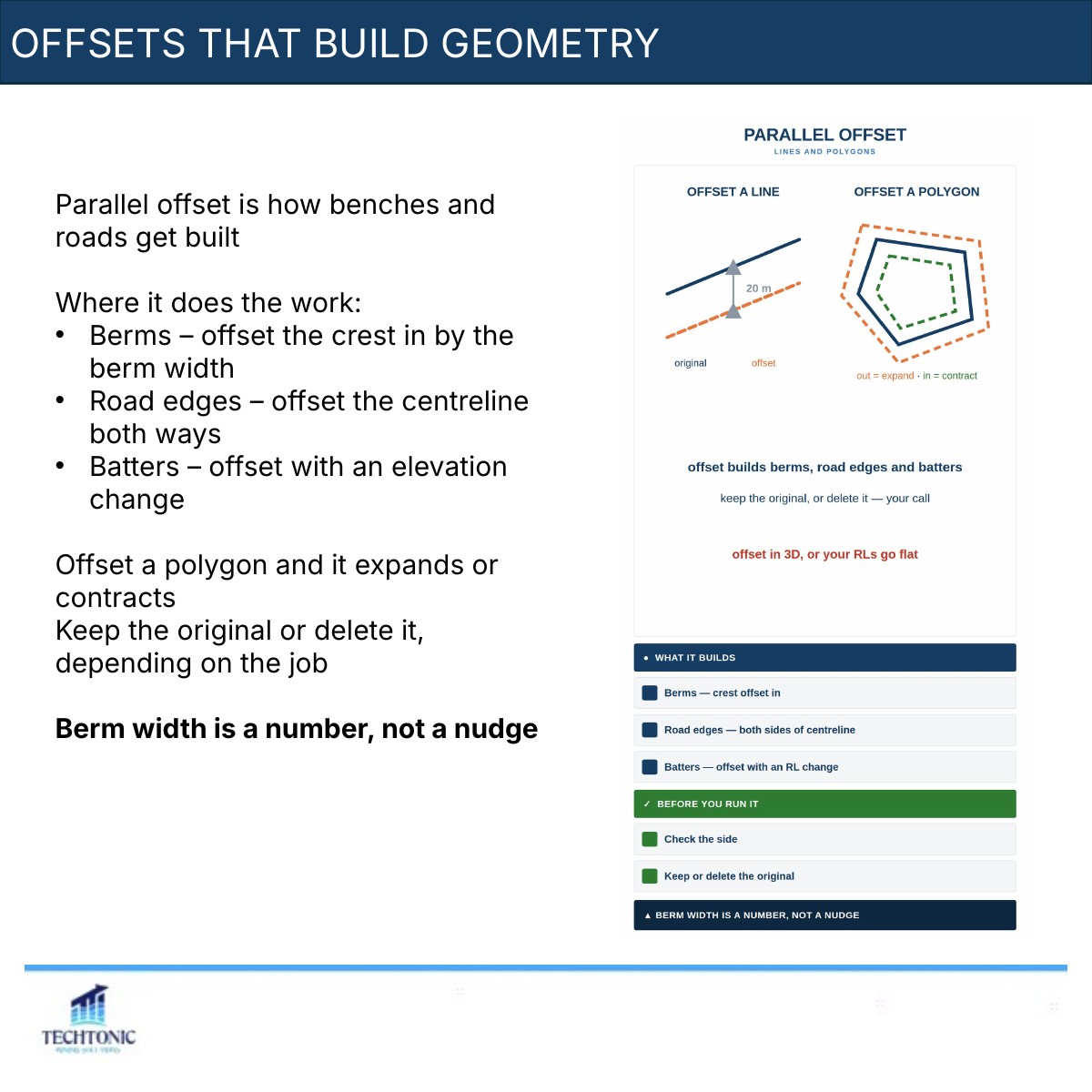
Parallel offset is how benches and roads actually get built:
- Berms — offset the crest in by the berm width
- Road edges — offset the centreline both ways
- Batters — offset with an elevation change
Offset a closed string and it expands or contracts. Whether you keep the original or delete it depends on the job. Either way, berm width is a number, not a nudge.
Spline and smoothing
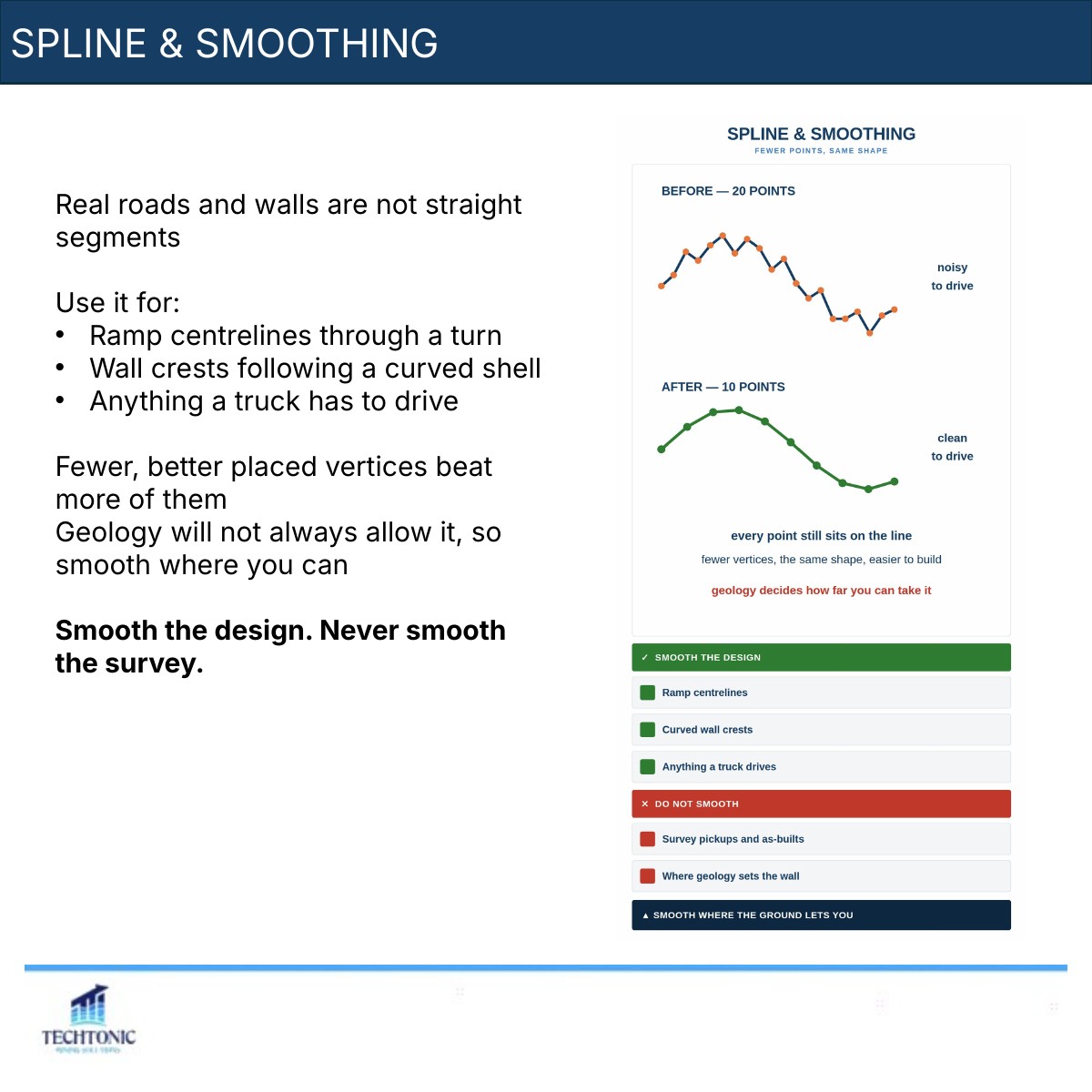
Real roads and walls are not straight segments. Ramp centrelines through a turn, wall crests following a curved shell, anything a truck has to drive — these need smoothing.
Fewer, better placed vertices beat more of them. Geology will not always allow it, so smooth where you can. And the rule that matters most: smooth the design, never the survey.
Copy, transpose and repeat
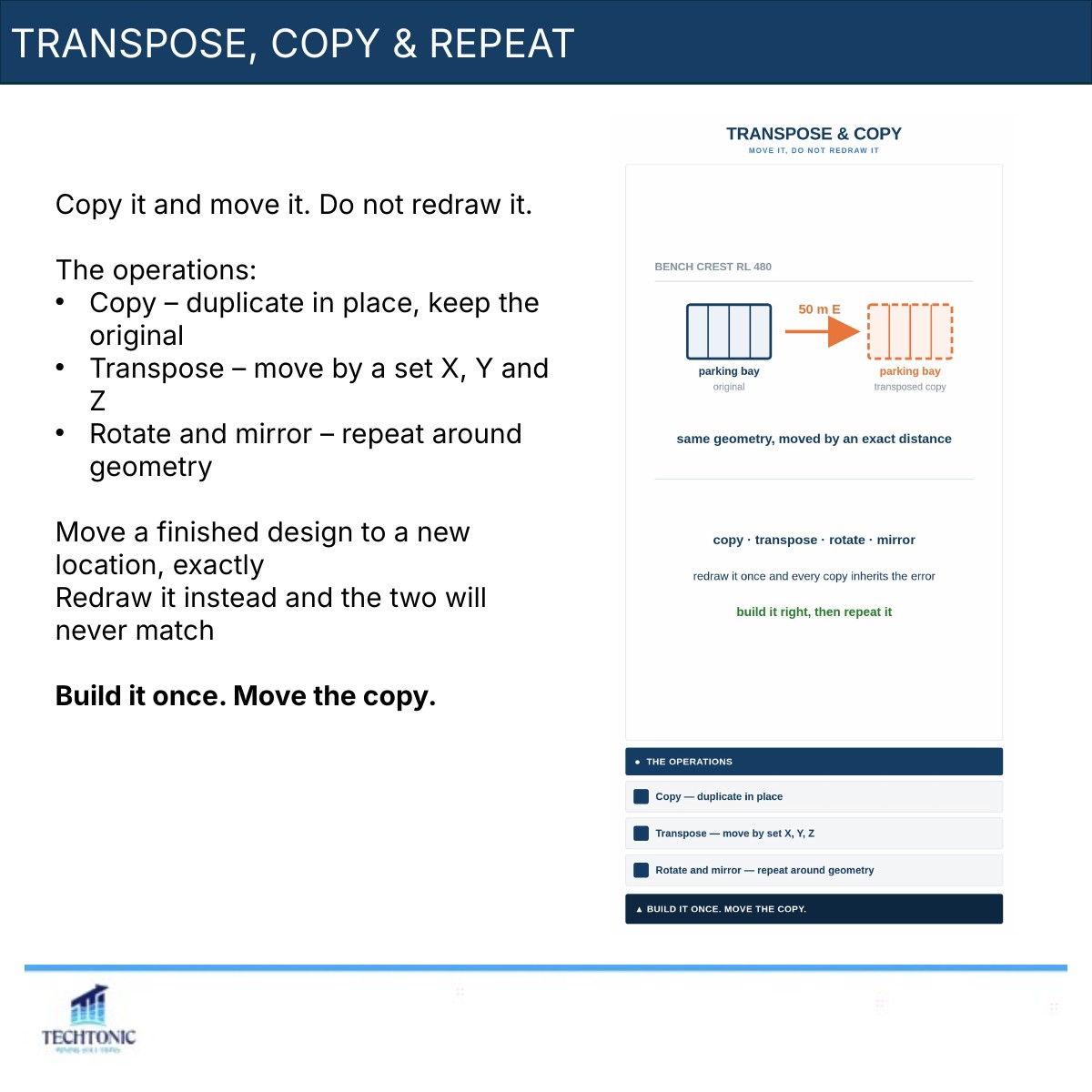
Copy duplicates in place and keeps the original. Transpose moves geometry by a set X, Y and Z. Rotate and mirror repeat it around other geometry.
Move a finished design to a new location and it lands exactly. Redraw it instead and the two will never match. Build it once, and move the copy.
Key takeaways
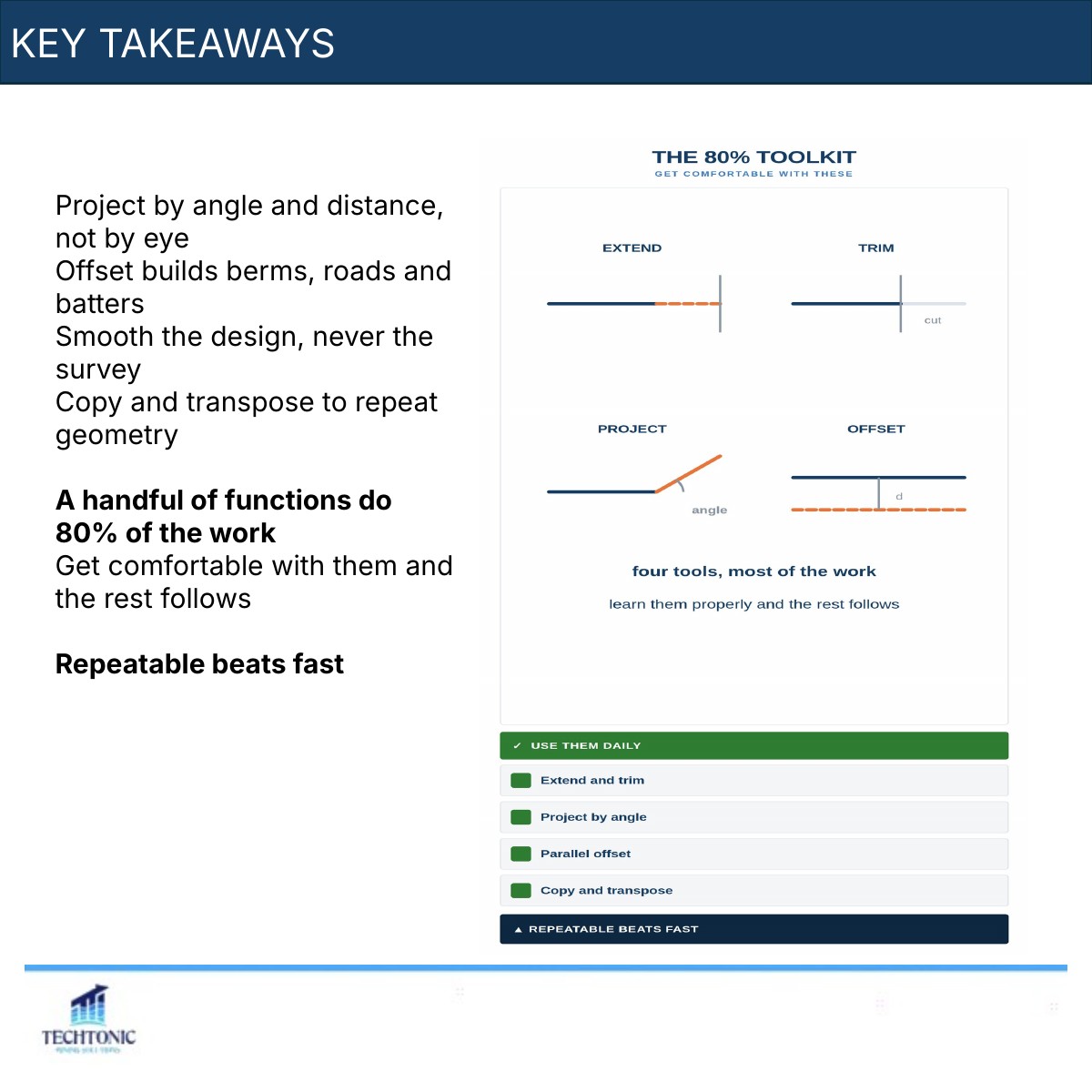
- Project by angle and distance, not by eye
- Offset builds berms, roads and batters
- Smooth the design, never the survey
- Copy and transpose to repeat geometry
We should never inherit or pass on designs that have been guesstimated or eyeballed. A handful of functions do 80% of the work — get comfortable with them and the rest follows. Repeatable beats fast.
The carousel
This piece began as a LinkedIn carousel. The full deck is below — use the arrows, or click any slide to enlarge.